- Item type
- Object
- Makers
- Watkins & Hill
- Provenance
- Presented by H.Minn
- Primary inscriptions
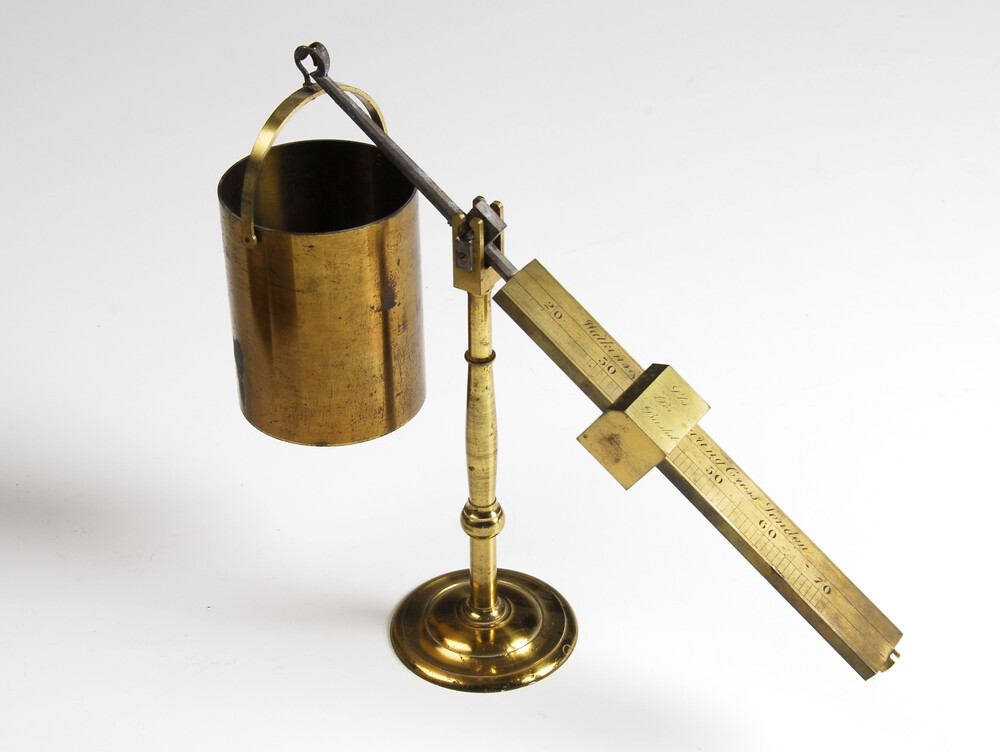
- Signed: "WATKINS & HILL, Charing Cross, LONDON."
- Object type
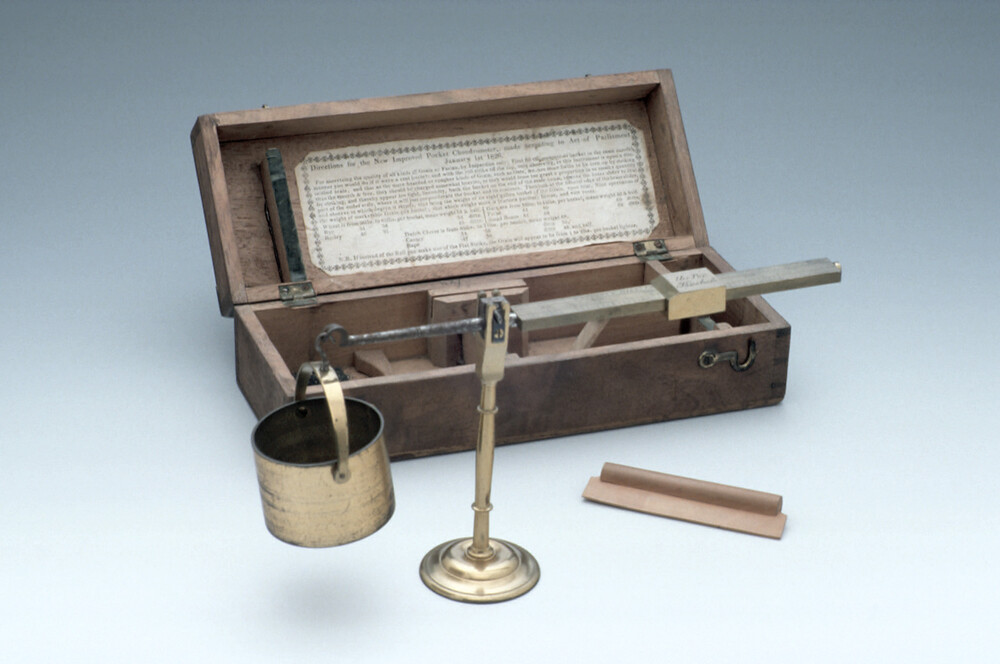
- Balance
- Dimensions
- Diameter: 150mm Height: 400mm Weight: 828g
- Inventory No
- 94227
- Accession Number
- 1928-56
Description
The long glass tube suspension housing is terminated by a torsion micrometer with Ivory scale of 180 divisions. The brass micrometer index terminates inside the suspension housing in a clamp with a fine wire; the latter is broken and has lost its horizontal indicator consisting of a glass or shellac rod ending at one end in a gilded pith ball and at the other in a paper counter balance and damping vane. The charge is introduced inside the dome by means of a small insulated brass rod and ball level with the pith ball of the indicator, which is also missing, its position is indicated by the perforation in the dome beside the suspension housing. The paper scale pasted on the outside of the glass dome at the height of the indicator is divided into 360 degrees, the zero point being opposite the indicator or index.
In 1784 C. A. Coulomb (1736-1806) demonstrated that the force of tension of a wire was proportional to the angle of twist, and with this principle forming the basis of his torsion balance, he established that both magnetic and electric attraction and repulsion were governed by the inverse square law. This law, in the case of electrostatics, had already been anticipated by J. Priestley in 1767, T. R. Robinson in 1769, H. Cavendish in 1771 (and very beautifully proven by means of his "globe and hemispheres experiment" also in 1771 but never published), but Coulomb was the first to demonstrate it convincingly by means of his torsion electrometer in 1785.
Coulomb's instrument was modified by Dellmann in 1842 and Kohlrausch in 1847. Different types of torsion wires were also used; by Coulomb silver wire, and in his most sensitive instrument he used a single silk fibre, while Kohlrausch found a glass torsion fibre the most accurate.