
- Subject
- Microscopy
- Item type
- Object
- Makers
- W. & S. Jones
- Provenance
- Purchased from Dr. Reginald S. Clay with his collection
- Primary inscriptions
- "W. & S. JONES, 30 Holborn, LONDON."
- Other inscriptions
- "R T Cobbold" written in ink on lowest foot of tripod.
- Object type
- Microscope
- Dimensions
- Height: 430mm Width: 25mm
- Inventory No
- 33238
- Accession Number
- 1944-1/20
Description
A turned pillar stands on a folding tripod base. A compass joint at the top of the pillar carries the square cross sectioned limb. The square stage is mounted on a sleeve with a rack and pinion, and moves on the limb for focusing. It has a recessed circular stage hole, three pinholes for accessories and a bracket to hold specimens. A sliding sleeve below the stage mounting carries a condensing lens and another sleeve at the lower end of the limb carries the Plano-concave mirror. An arm with a threaded ring on the end is mounted on a rack and pinion mechanism at the top of the limb. The narrow nosepiece of the body tube fits the thread. The body has an eyepiece with two lenses and a field lens. A rotating disk with six objectives screws onto the end of the arm. This can be replaced with individual objectives. The supports in the fitted, mahogany case are faced with blue velvet. The case also contains accessories comprising two objectives with dust caps, three objective Lieberkühn's and one plain Lieberkühn, two stage forceps, an illuminating lens on a copper alloy stalk, a sub stage aperture cone, a live box, a Bonnani stage, Martin's triple stage with removable discs, a fishplate, a set of tweezers, an ivory talc box, a copper alloy wet cell, a stage clip, Lieberkühn carrier on a stalk, eyepiece lens in collar, copper alloy collar, twenty slides including six ivory slides, three wooden ones and six box slides and lists of specimens for each.
Related Items
More related items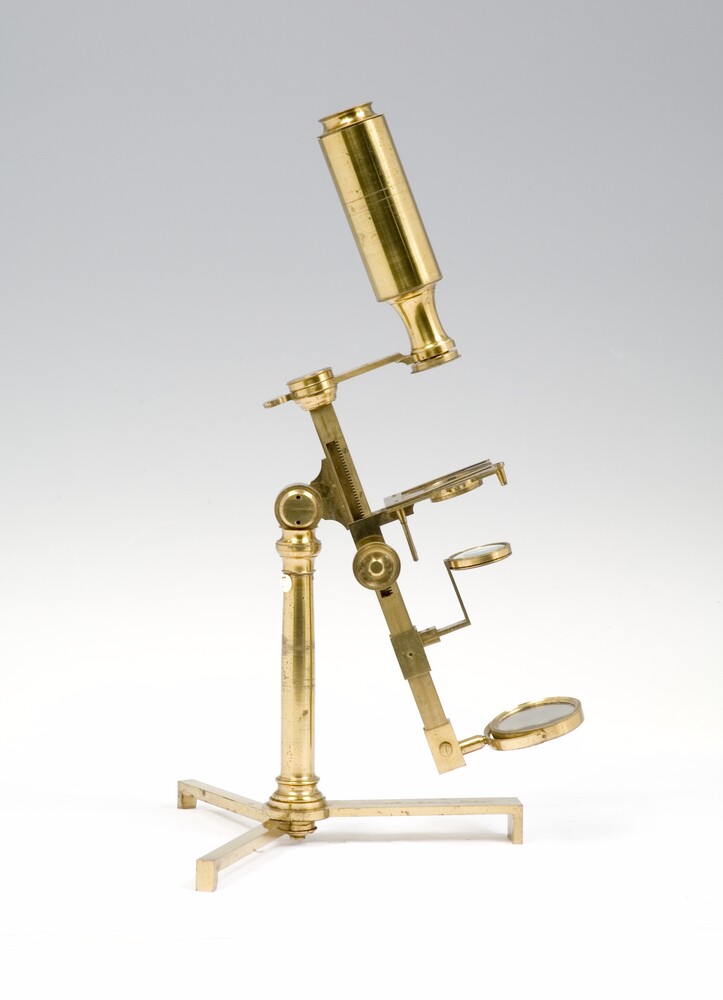 Compound Microscope in Case with Accessories, by W. & S. Jones, London, c. 1800Inventory Number 46229
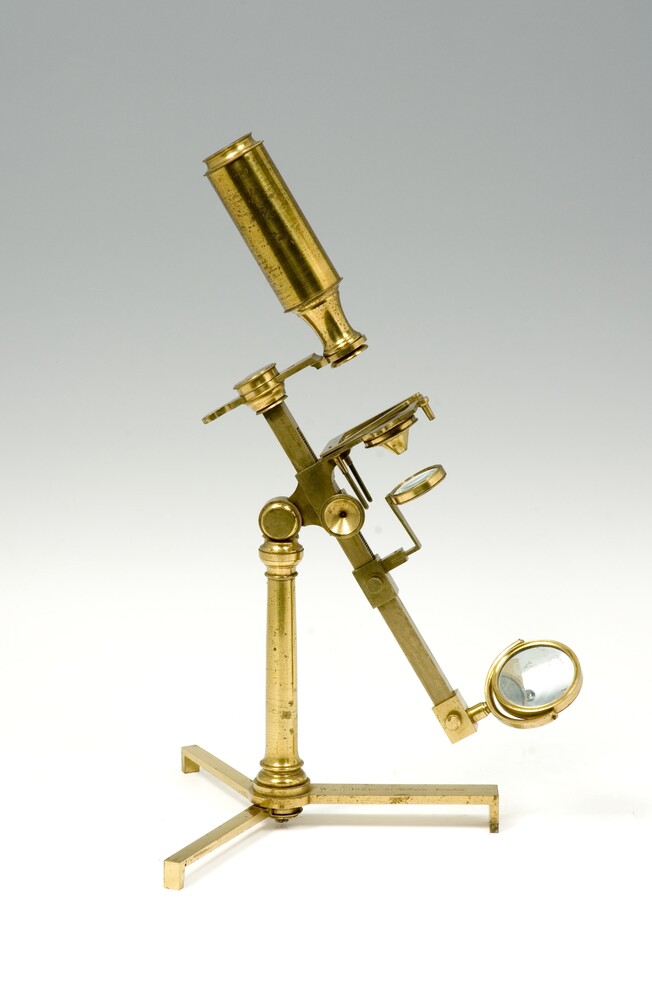 Compound Microscope in Case with Accessories and Specimens, by W. & S. Jones, London, c. 1800-25Inventory Number 35727
- Compound Microscope with Accessories and Case, by W & S Jones, London, c. 1795Inventory Number 41158
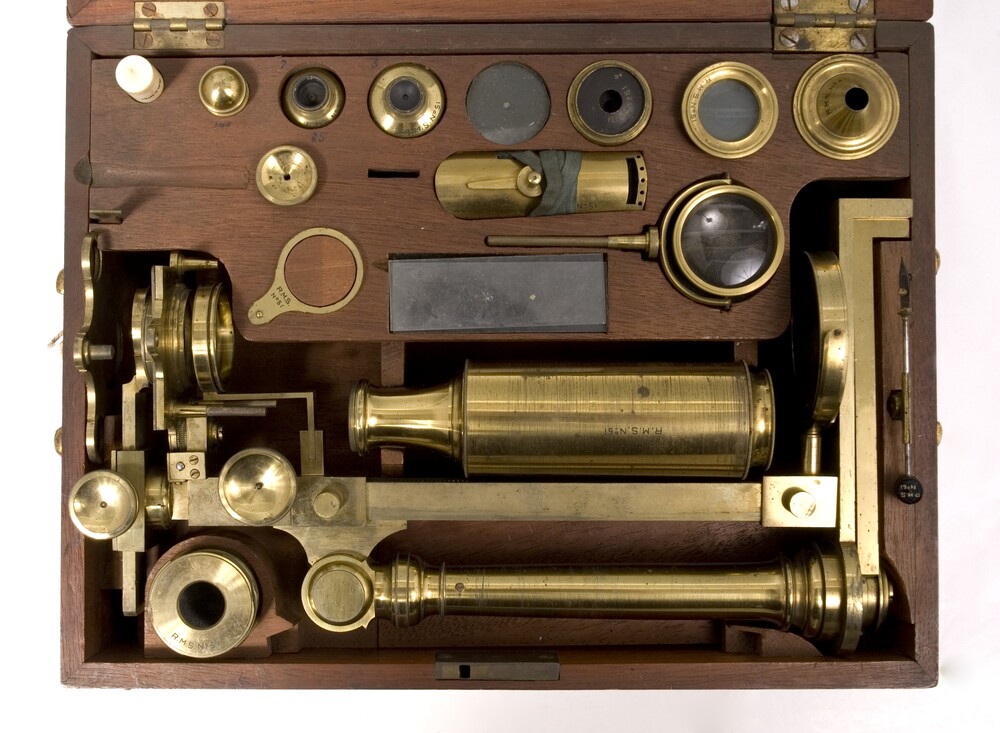 Simple and Compound Microscope with Case and Accessories, by W and S JonesInventory Number 10218