
- Item type
- Object
- Makers
- Henry G. Moseley
- Provenance
- Used by H.G.J. Moseley at the Electrical Laboratory, Oxford. Donated by the Physics Department, University of Oxford, 1935. See 'Accession Record: Extract from Annual Report for 1935' narrative.’
- Dimensions
- Height: 210mm Width: 212mm Depth: 42mm Weight: 116g
- Inventory No
- 24646
- Accession Number
- 1935-8
Description
Glass tube with three ends, one is wider than the others and slightly funnel like, the other two ends are thinner and one is ringed with wax. The glass is slightly bulbous and is attached to the rest of the glass by white wax. Inside the glass is a loose trolley bobbin with a section of string attached.
These pieces This piece of apparatus were was constructed and used by Henry Moseley, first at Manchester in 1913 and then at Oxford from November 1913 to the summer of 1914. He studied chemical samples using X-ray spectroscopy and hence determine their atomic number. The results were published in the ‘Philosophical Magazine’ in 1913 and 1914.
The trolley bobbin tube used a small trolley to move the target chemical element samples along a 'track', pulled by a cord wound around a copper alloy bobbin. This meant the trolley could be moved without breaking the vacuum and hence the experimental apparatus did not need to be pumped out every time the sample was changed. This was a system of Moseley's own construction and design and meant his scientific experiments could be conducted quicker.
See attached narrative 'Henry 'Harry' Moseley and his experiments' for further details.
Related Items
More related items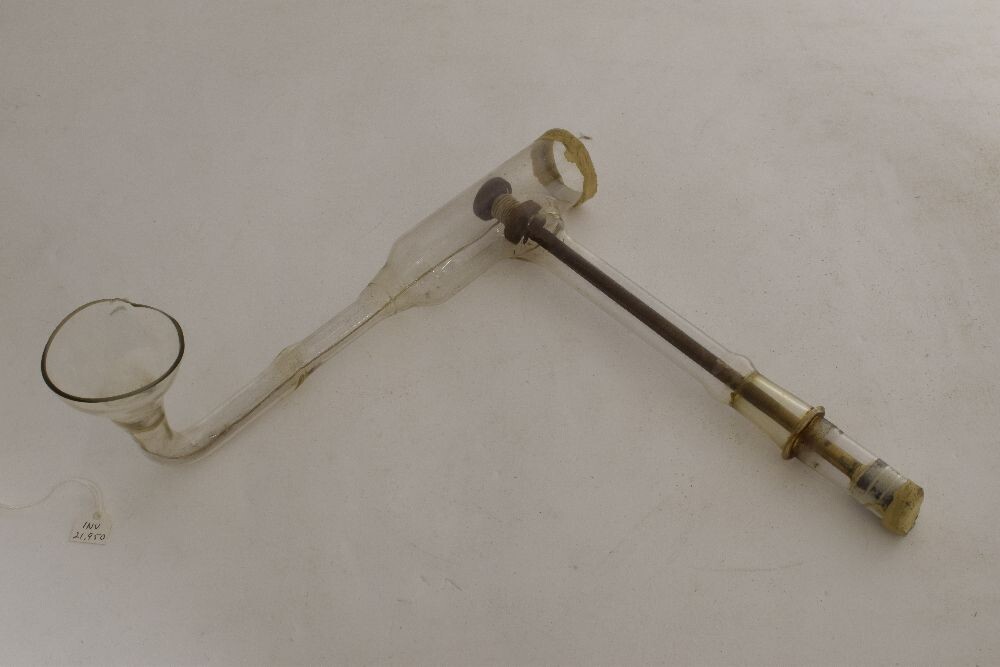 Spare Tube with Trolley Bobbin, by H.G.J. Moseley, Manchester/Oxford, c.1913Inventory Number 21950
- Main X-Ray Tube and Trolley Bobbin Tube, by H.G.J. Moseley, Manchester/Oxford, c.1913Inventory Number 19106
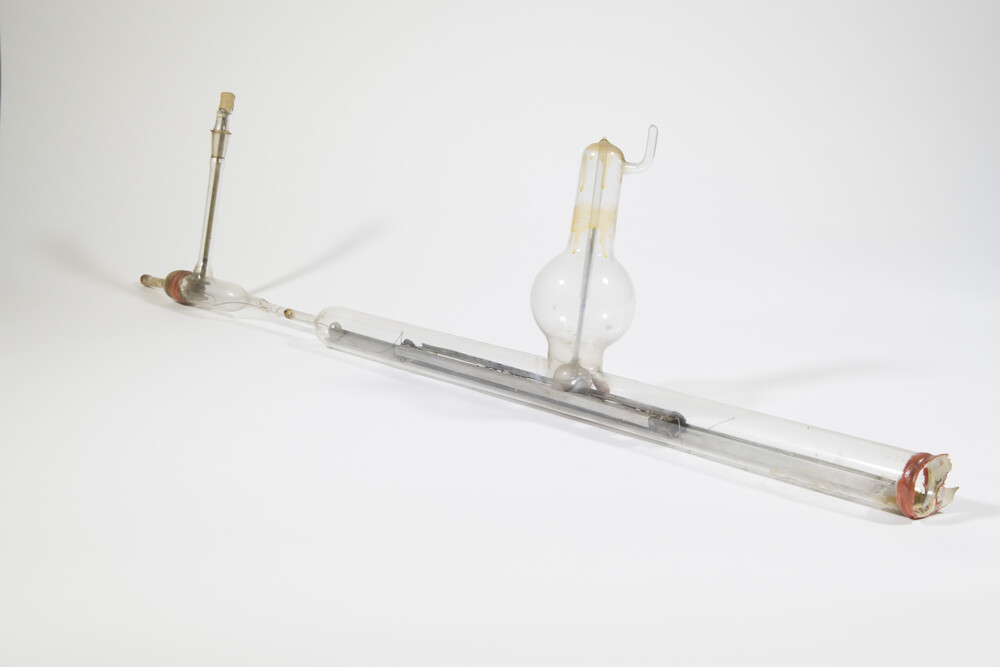 X-Ray Tube with Trolley, Bobbin and Line, by or for H.G.J. Moseley, Oxford, 1914Inventory Number 30436
- Trolley Apparatus for Target Samples, by H.G.J. Moseley, Manchester/Oxford, c.1913Inventory Number 22996