- Item type
- Object
- Provenance
- Presented by the Frome Literary and Scientific Institution, Somerset.
- Primary inscriptions
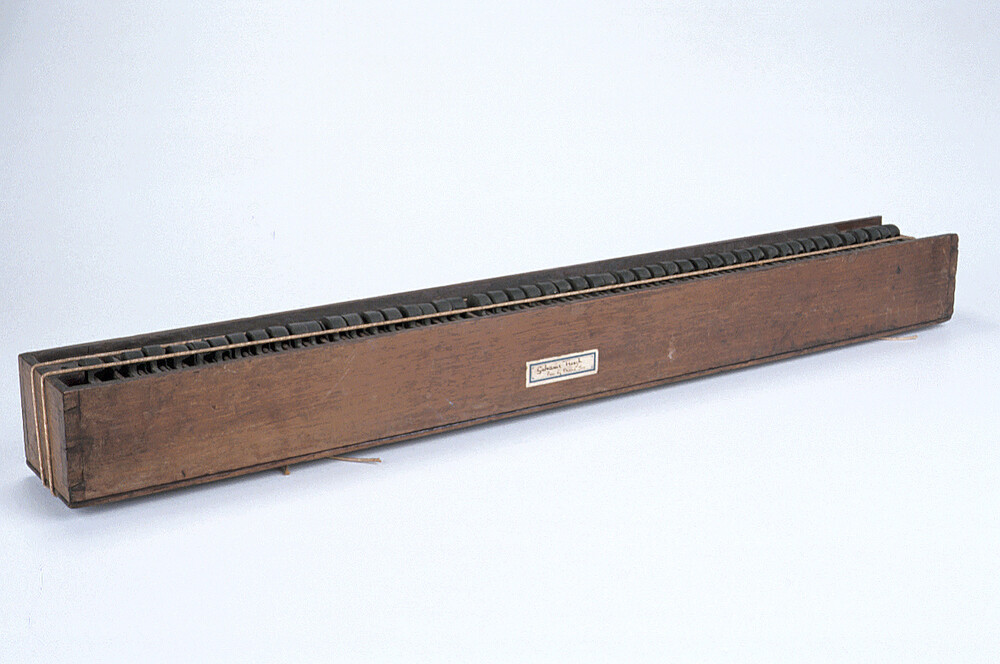
- Handwritten museum identification label "Voltaic Battery, 36 couples | Frome"
- Object type
- Battery
- Dimensions
- Height: 350mm Width: 69mm Depth: 62mm Weight: 2844g
- Inventory No
- 75435
- Accession Number
- ?1939-2
Description
The cells are each made of zinc and copper plates. They are set in the mahogany box at equal distances apart and surrounded by the electrolyte. The inner surface of the box is insulated with sealing wax.
William Cruickshank (1801) devised the trough battery consisting of 60 pairs of zinc and silver plates 1 1/2 inches square, cemented with rosin in a trough so that all the zinc plates faced one way and all the silver plates the other way. The cells were 'charged' with dilute ammonium chloride solution. William Pepys used zinc and copper plates (1803) and dilute 'nitrous acid'. Humphry Davy used three such batteries in his famous experiments separating potassium and sodium from their compounds. This type of battery would be active for several weeks.