
- Brief Description
- This Andalusian astrolabe was made in Seville, modern-day Spain, in 1221 during the time of the Muslim Almohad Empire which ruled over Morocco and part of Spain. Seville was an important centre, of equal importance to the capital Marrakesh. The object is signed and dated to the year 618 of the hijra. Another object in the Museum's collection (HSM inv. 50934) was made by the same maker, in Seville, about three years before.
- Subject
- Astrolabes
- Item type
- Object
- Provenance
- Presented by Lewis Evans Bought by Evans in Paris through Vitali (April 1910).
- Primary inscriptions
- بسم الله صنعه محمد بن فتوح الخمايري بمدينة إشبيلية في سنة خيح الهجرة. "In the name of God. Made by Muhammad ibn Fattuh al-Khama'iri in the city of Seville in the year 618 of the Hijra". Engraved on the back of the throne. اثبت في جدول الحدود و الدر نجانات و الوجوه و المثلثات رسوم الكواكب باواخرحر و فاسمايها "I have set in the table the limits, dignities, and the faces, and the triplicities and the signs of the stars according to the last letters of their names". Engraved in a circle in the middle of the womb.
- Physical material
- Brass
- Object type
- Astrolabe
- Dimensions
- Diameter: 200mm Height: 256mm Depth: 47mm Weight: 2299g
- Inventory No
- 44141
- Accession Number
- 1924-0/part
Description
A fine astrolabe of the maghrebi, North African style. Differently from the other object in the Museum's collection made by the same maker (HSM inv. 50934), this astrolabe does not have the silver knobs at the base of its stars, though the scales around the rim are notched, showing that the maker was experimenting with different ways of making the object usable at night, in poor light conditions.
Parts
It comprises: a mater, a rete, 5 platese, a horse and pin. The alidade is missing.
Throne
The throne is typical of Maghrebi astrolabes. It is attached with a integrated base. The front of the throne is undecorated. The back bears the maker's inscription.
Ring
The ring is of the simple, squared cross-section type.
Shackle
Shackle of the omega type (i.e. Ω-shaped shackle).
Mater
The mater and limb are of two pieces, soldered construction. The rim is marked with a degree scale 0-360° divided every 5 degrees, subdivided every degree, and labelled in Abjad numerals every 5 degrees. The scale is notched every 15 degrees to facilitate the use in poor light.
Womb
The womb is marked with 10 concentric rings. The first four rings contain 2 scales of terms. The next ring contains a scale of triplicities, then a zodiacal calendar, another scale of triplicities, while the three innermost rings contain increments of fortune, decans, faces.
A central ring contains an inscription.
Back
The back is worn and parts are illegible. It contains 8 concentric scales: two altitude scales on the upper half of the rim 0-90° divideed and notched every 5 degrees, subdivided every degree and labelled in Abjad numerals every 5 degrees; a zodiacal calendar divided in 30 degrees labelled every 5 degrees on top of each sign; a Julian calendar with a scale of the days of the month, is divided every 5 days, subdivided every day, and labelled every 5 days plus the last day; a perpetual calendar for a 28-year cycle.
There is a shadow square in the central, lower half, both the the left and right sides are divided into 12 fingers vertical and 12 fingers horizontal, marked every 2. The lower half of the rim is marked with a shadow scale projection.
Rete
The rete is of the Maghrebi type with hook star pointers (4 of which are broken), some with inverted-heart bases, some with simple loops. It features 29 stars. Two knobs for rotation are missing.
Zodiac label
The zodiac on the rete is labelled: الحمل , الثور , الجوزا , السرطان , الاسد , السنبله , الميزان , العقرب , القوس , الجدي , الدلو , الحوت.
Pin and horse
The rete is attached using a pin and horse. The horse is a replacement.
Alidade
The alidade is missing.
Plates
There are 4 plates, for latitudes 30°, 31°, 33°, 34°, 36°, 37° and 41°. They are engraved with almucantars for every 3 degrees, azimuths for every 5 degrees, 12 unequal hours labelled in both Abjad numerals and words and 5 lines of Muslim prayers. They are marked المشرق (east) and المغرب (west). Some lines for Muslim prayers are roughly engraved on one of the plates.
Related Items
More related items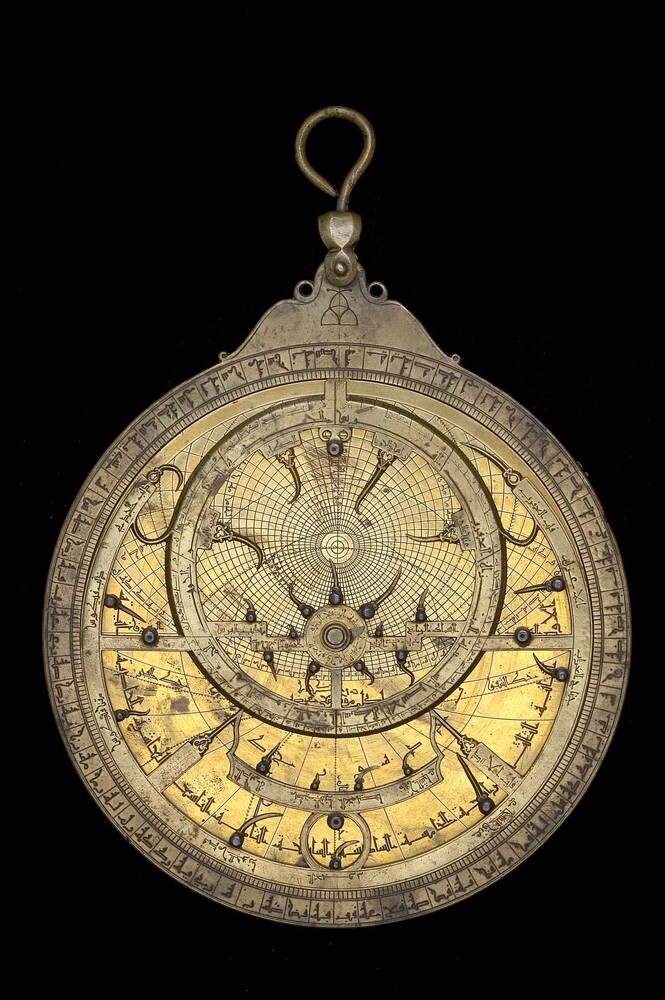 Astrolabe, by Muhammad ibn Fattuh al-Khamairi, Seville, 1224/5Inventory Number 50934
 Astrolabe, by Khalil Muhammad ibn Hasan `Ali, Persian, c. 1700Inventory Number 42649
 Astrolabe, by Muhammad ibn Ahmad al-Battuti, North African, 1728/9Inventory Number 52713
 Astrolabe, by Diya al-din ibn Qaim Muhammad, Indo-Persian, 1653/4Inventory Number 38862