
- Brief Description
- This Andalusian astrolabe was made in Seville, modern-day Spain, in 1224 during the time of the Muslim Almohad Empire which ruled over Morocco and part of Spain. Seville was an important centre, of equal importance to the capital of the empire, Marrakesh. An interesting feature of this astrolabe is the presence of silver knobs at the bases of 21 stars as well as four silver knobs for turning which, when polished, would have made the object shine with silvery stars a useful features when the instrument is used in a poor light. The object is signed and dated to the year 621 of the hijra. Another object in the Museum's collection (HMS inv. 44141) was made by the same maker, in Seville, about three years before.
- Subject
- Astrolabes
- Item type
- Object
- Provenance
- Presented by Lewis Evans. Formerly the property of Dr E.B. Knobel, F.R.A.S., who bought it at Edinburgh in 1876 in a second-hand shop.
- Primary inscriptions
- بسم الله هذا ما صنع محمد بن فتوح الخمائري بمدينة ٳشبيلية في سنة خكا الهجرية "In the name of God. This is what Muḥammad ibn Fattūḥ al-Khamāʾirī made in the city of Seville in A.H. 621". Engraved on the back of the throne.
- Object type
- Astrolabe
- Dimensions
- Height: 257mm Width: 187mm Depth: 17mm Weight: 1.65kg
- Inventory No
- 50934
- Accession Number
- 1924-0/part
Description
A fine astrolabe of the maghrebi, North African style. Two of its plates have the name Marrakesh and Fez added above the latitude by an unexperienced hand, showing that a possible owner, at a certain point of the object's life, decided to add this extra information, likely for the two plates she/he used the most.
Parts
It comprises: a mater; a rete, 5 plates, a horse and pin, an alidade.
Throne
The throne is of the simple type, attached with a integrated base. This throne is composed of two pieces: the front, which is integrated with the limb, and the back, which is an extension of the back plate. The front features a decorative motif and the back the maker's signature.
Ring
The ring is a hook of the simple, round cross-section type.
Shackle
Shackle of the eye-bolt type. The large eye-bolt attaches to a bracket, which then attaches to the throne.
Mater
The mater and limb are of one-piece construction. The rim is marked with a degree scale 0-360° divided every 5 degrees, subdivided every degree, and labelled in Abjad numerals every 5 degrees. It is engraved as a tablet of ecliptical co-ordinates (i.e. for latitude 66 1/2°).
Womb
Contains a table of ecliptic coordinates.
Back
The back contains 8 scales: two altitude scales on the upper half of the rim 0-90°, divided every 5 degrees, subdivided every degree, labelled every 5 degrees in Abjad numerals and notched on the left-hand side; a zodiacal calendar divided in 30 degrees labelled in Abjad numerals every 5 degrees on top of each sign; a Julian calendar with a scale of the days of the month, is divided every 5 days, subdivided every day, and labelled every 5 days plus the last day; a prepetual calendar for a 28-year cycle.
The back also contains a shadow square in the central, lower half, both the the left and right sides are divided into 12 fingers vertical and 12 fingers horizontal, labelled every 2. The lower left and lower right quadrant of outer circle features a double cotangent scale 15-40 fingers labelled every 3 until 24 and then every 4.
Rete
The rete is of the Maghrebi type with hook star pointers some with inverted-heart bases and some with silver rivets at the bases. A circle connects the Tropic of Capricorn to the band of the equator. There are 4 silver knobs for rotation. It features 29 stars.
Zodiac label
The zodiac on the rete is labelled: الحمل , الثور , الجوزا , السرطان , الاسد , السنبله , الميزان , العقرب , القوس , الجدي , الدلو , الحوت.
Pin and horse
The rete is attached using a nut and bolt. A small, square nut thread on to an equally small bolt. The head of the bolt has a small pointer extending from it. The shank of the bolt is square and fit into the square hole on the alidade. This ensured that the pointer on the front of the instrument was always colinear with the alidade on the back.
Alidade
Double-ended. The sights that were originally on this alidade have since broken off and are now missing.
Plates
There are 5 plates with latitudes 31°, 32°, 33°, 34°, 35°, 36°, 37°, 38° and 40°. They are engraved with almucantars for every 3 degrees, azimuths for every 5 degrees, 12 unequal hours labelled in both Abjad numerals and words and 5 lines of Muslim prayers. They are marked المشرق (east) and المغرب (west).Two of its plates have the name Marrakesh and Fez added above the latitude by an unexperienced hand, possibly an owner. The numbers of the unequal hours are spelled out in words.
Related Items
More related items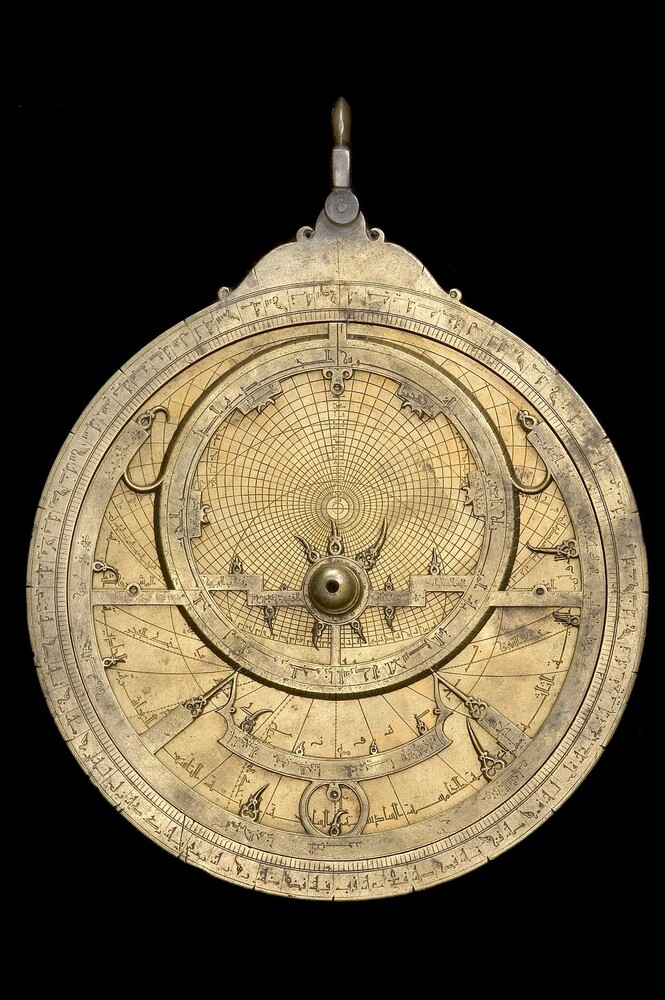 Astrolabe, by Muhammad ibn Fattuh al-Khama'iri, Seville, 1221/2Inventory Number 44141
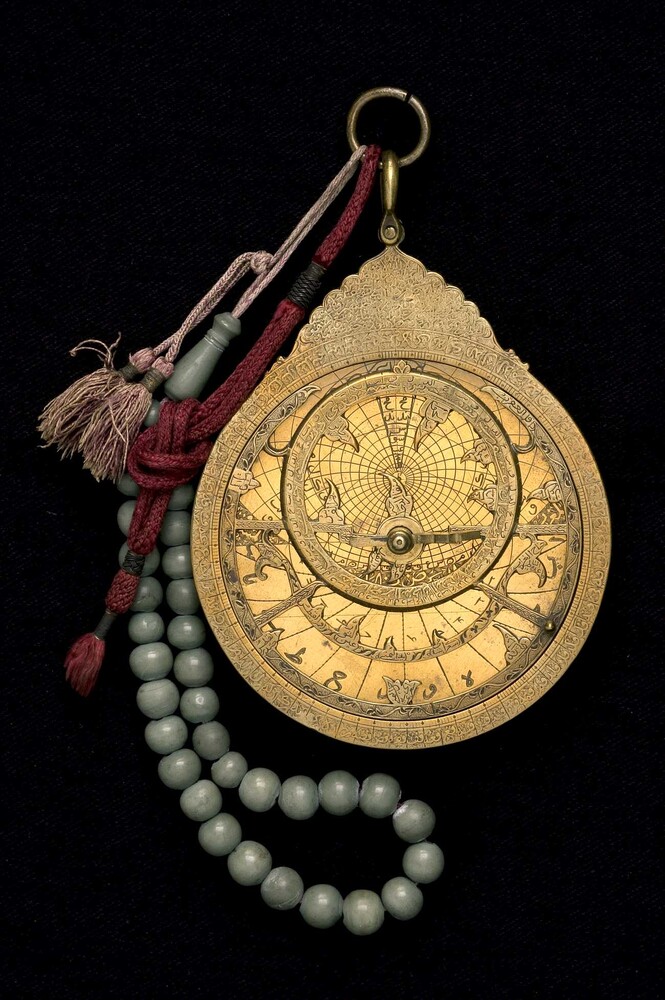 Astrolabe, by Khalil Muhammad ibn Hasan `Ali, Persian, c. 1700Inventory Number 42649
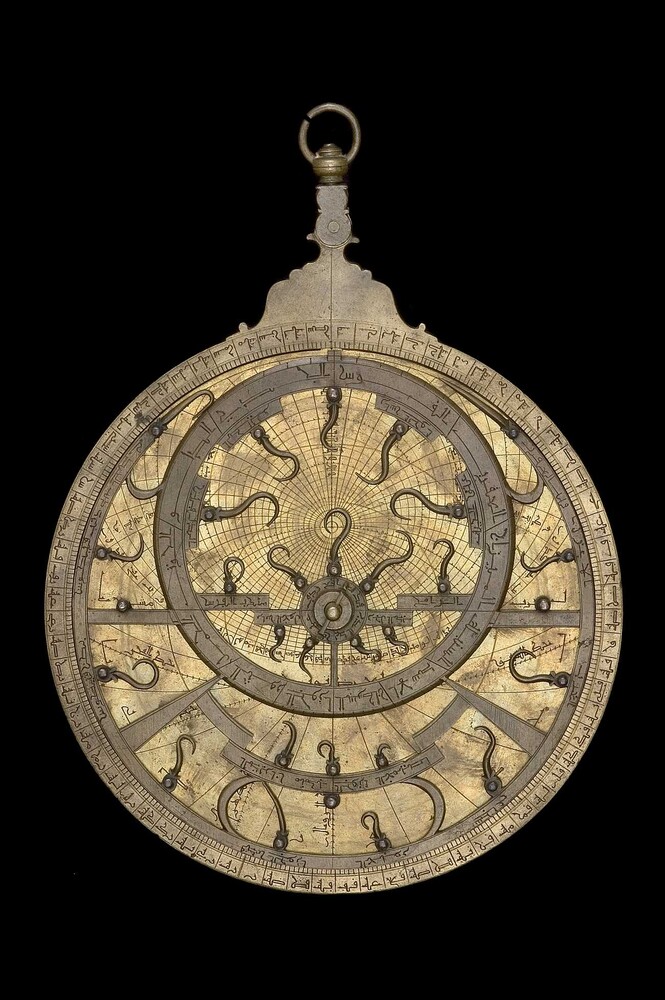 Astrolabe, by Muhammad ibn Ahmad al-Battuti, North African, 1728/9Inventory Number 52713
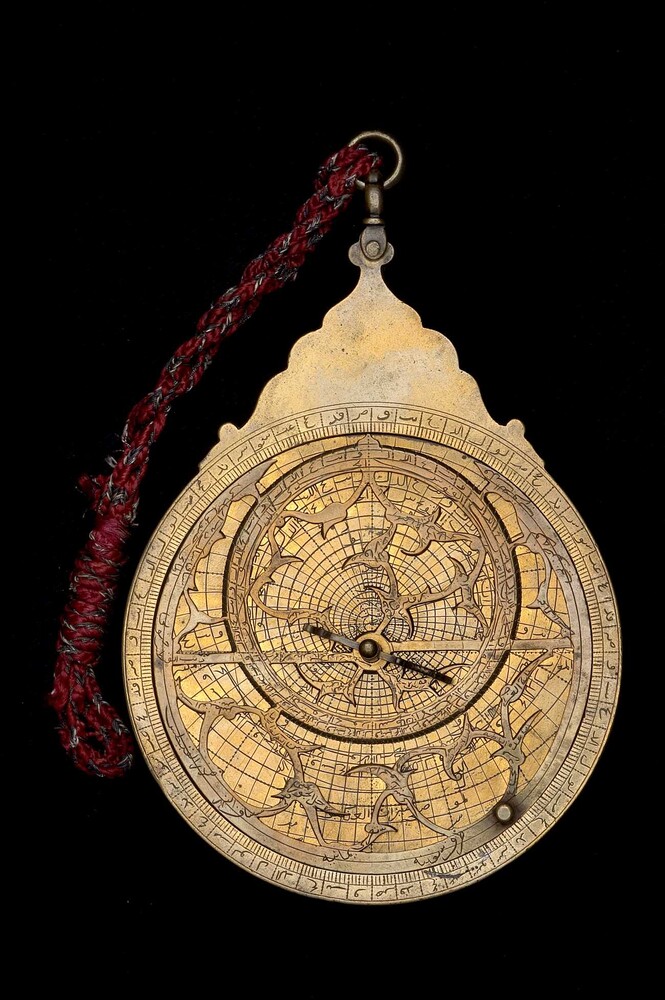 Astrolabe, by Diya al-din ibn Qaim Muhammad, Indo-Persian, 1653/4Inventory Number 38862