
- Brief Description
- This astrolabe is a very rare example of a 'Universal Lamina'; it differs somewhat from the instrument described in the Libros del saber. The only other example known of an Islamic 'Universal Lamina' is the astrolabe by Ahmad bin Abi Bakr of 729 A.H., in the Benaki Museum in Athens. The 'Universal Lamina' described in the Libros del saber (c.1277) of Alfonso el Sabio, of Castile, was probably invented at Toledo in the 1000s CE by the astronomer Abu-l-Hasan Ali bin Khalaf ibn Ahmad. It was a precursor of the so-called az-Zarqellu projection (the saphæa arzachelis), also developed in Muslim Toledo in the 1000s CE. It reappeared in Europe in the 1500s CE as the 'Mathematical Jewel' of John Blagrave.
- Subject
- Astrolabes
- Item type
- Object
- Provenance
- Purchased from Ernst Weil with a grant from Lord Leigh's Fund in 1957. Formerly in the L. Lapicirella Collection, Florence.
- Primary inscriptions
- صنعه علي بن ابراهيم الجزار المعذ في تازى حرسها الله سنة ذكد "Made by Ali ibn Ibrahim al-Harrar, the muezzin, in Taza, God protect her, in the year 724 A.H." Engraved on the back of the upper left-hand quadrant.
- Physical material
- Brass
- Object type
- Universal astrolabe
- Dimensions
- Diameter: 220mm Height: 272mm Depth: 33mm Weight: 0.643kg
- Inventory No
- 50853
- Accession Number
- 1957-19
Description
Parts
It comprises: a mater, a rete, an alidade, a screw pin.
Throne
The throne is of the simple type and it is attached with an integrated base. The throne is pierced by two small holes on each side of the shackle. The front is integrated with the limb; the back with the back plate.
Ring
The ring is of the simple, squared cross-section type (i.e. a simple ring made from a round rod or piece of metal).
Shackle
Shackle of the omega type (i.e. Ω-shaped shackle).
Mater
The mater and limb are of two pieces, riveted construction. The rim is marked with a degree scale 0-360° divided every 5 degrees, subdivided every degree, and labelled in Abjad numerals every 5 degrees.
Womb
The womb contains a universal projection with an set of almucantars for 90°.
Back
On the back shown above, are a zodiac/calendar scale (0° Aries = 13.5 March; concentric type); an unequal-hour diagram; a sine and cosine graph; a shadow-square; and the usual scales of degrees.
Rete
The rete is of the leaf type and it a "Universal Lamina". The rete of this instrument is made for 58 stars.
The 'Universal Lamina' is a combination of a rete similar to that of a conventional astrolabe, super-imposed on a universal projection of the type used by az-Zarqellu. The rete is usually divided into two halves along the Eest-West line, the tracery in the upper half representing almucantars and azimuths, that in the lower half being part of the usual stereographic projection, on the plane of the Equator, of the ecliptic and certain fixed stars. The outer circle of the rete represents the Equator and not, as on a conventional rete the Tropic of Capricorn. The almucantars and azimuths usually found in the upper half, have been replaced by the second half of the ecliptic circle and a further selection of fixed stars. The so-called Zarqellu projection below the rete is of the usual type, to which have been added azimuth circles, as on a normal astrolabe plate for latitude 90°. The result is that for certain operations it is convenient to use the rete at the same time considering the Zarqellu projection as an ordinary plate for latitudes 0° and 90°; and for other operations to use the universal projection and to ignore the rete.
Zodiac label
The zodiac on the rete is labelled: الحمل , الثور , الجوزا , السرطان , الاسد , السنبله , الميزان , العقرب , القوس , الجدي , الدلو , الحوت.
Pin and horse
The rete is attached using a rivet. Although the head of the rivet is slotted as if it were a screw, it rotates freely an does not unscrew. There is no apparent way to remove this rivet and thus inspect the back of the rete or rule.
Alidade
Double-ended. The rule has an usual triangular cross-section.
Related Items
More related items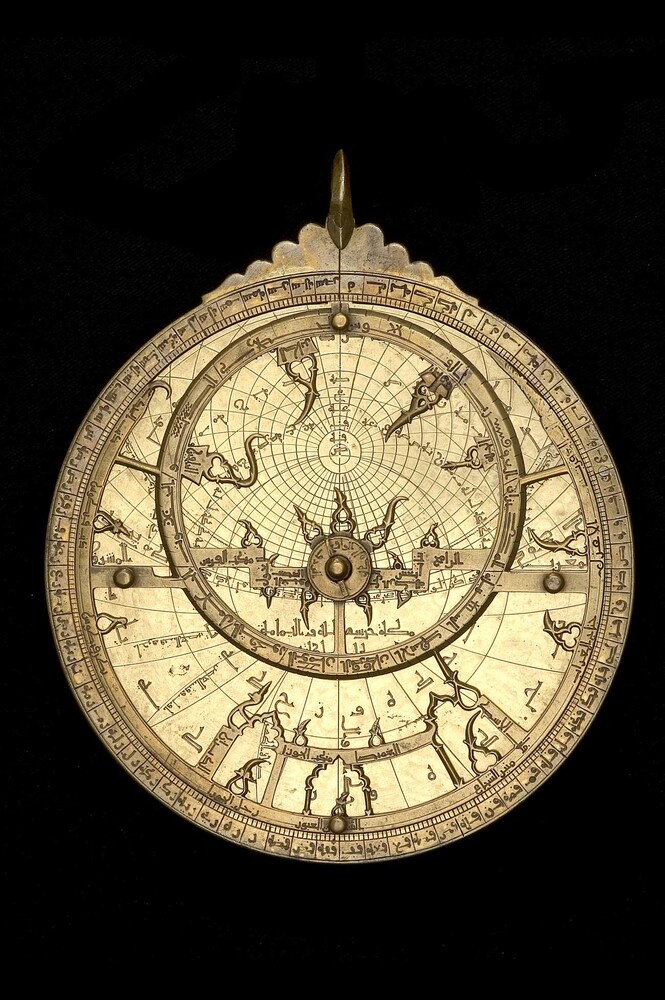 Astrolabe, by Ibrahim ibn Sa'id al-Sahli, Toledo, 1068Inventory Number 55331
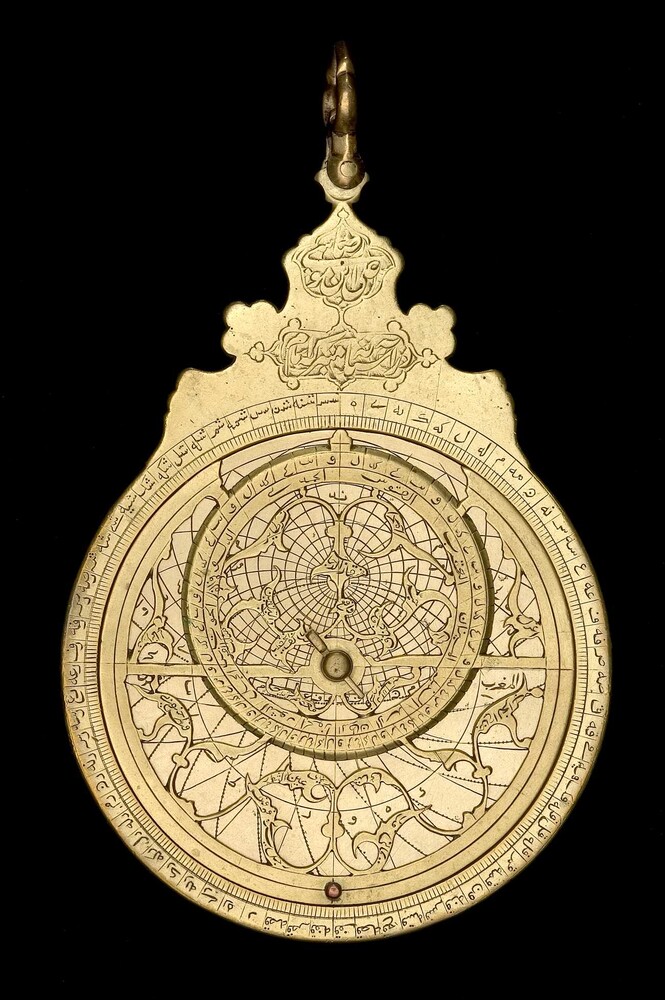 Astrolabe, by Ibrahim ibn Sharaf ad-din Husayn, Persian, 1641Inventory Number 43148
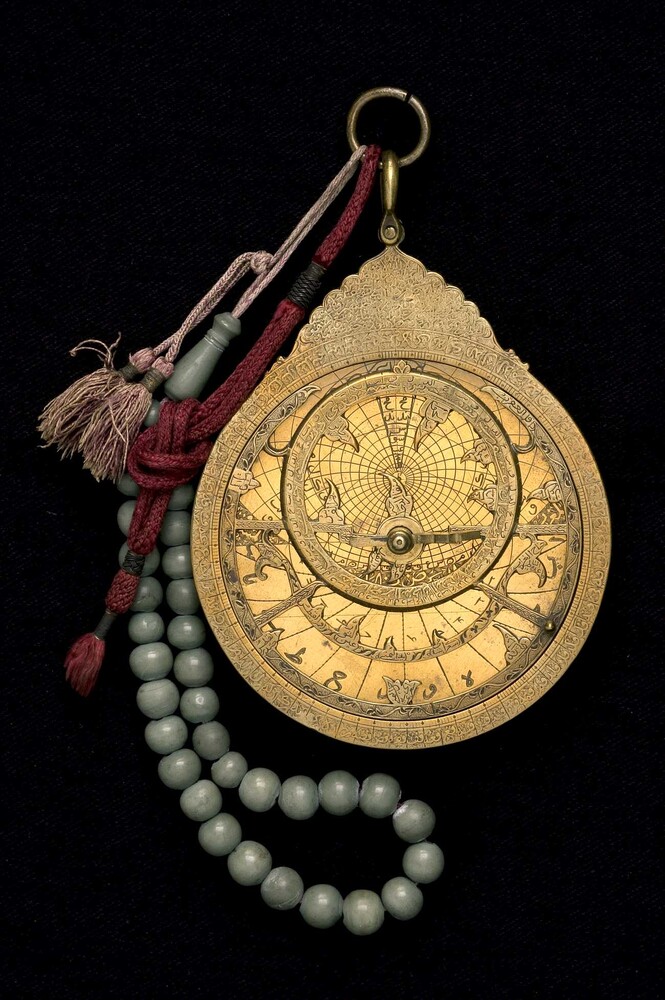 Astrolabe, by Khalil Muhammad ibn Hasan `Ali, Persian, c. 1700Inventory Number 42649
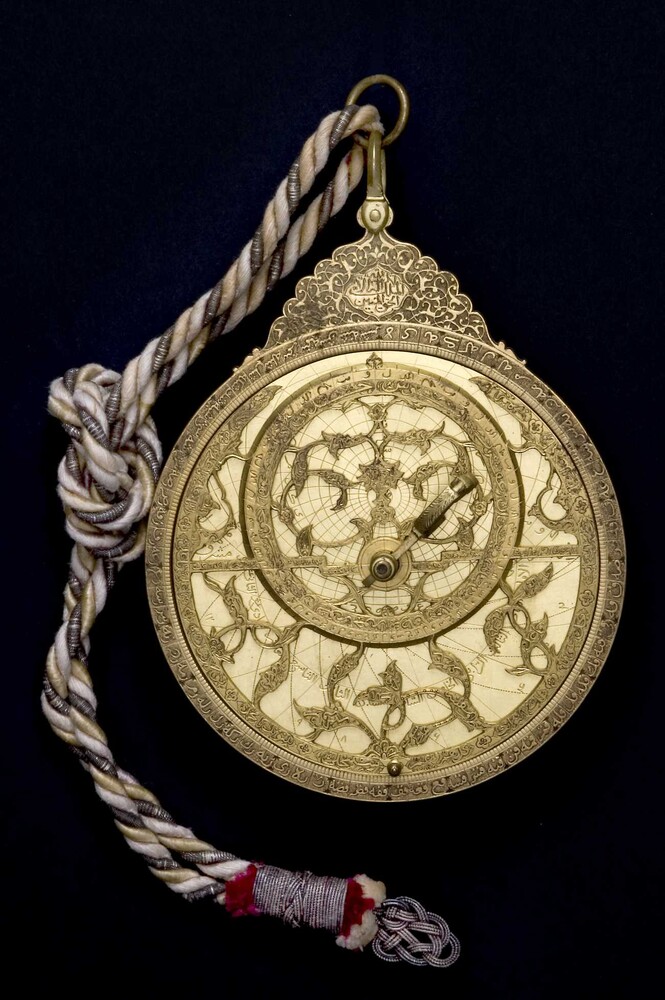 Astrolabe, by Khalil Muhammad ibn Hasan `Ali and Abd al-A'imma, Persian, c.1700Inventory Number 50987