
- Brief Description
- This is the earliest European astrolabe in the Museum's collection. It was made in 1068 in Muslim Spain, in the city of Toledo, just south of Madrid. During this time Toledo had detached from the Umayyad Caliphate of Cordoba, which ruled the region, and remained an independent Muslim/Berber polity called Taifa of Toledo, until it was conquered by Christian forces in 1085. Toledo was a great cultural centre for Muslims, Christians, and Jews alike and a site for collaboration and exchange of ideas. Such fruitful exchanges are also reflected in the use of both Arabic and Latin characters in the calendar featuring on the back of this instrument.
- Subject
- Astrolabes
- Item type
- Object
- Provenance
- Presented by Lewis Evans. Evans purchased it from Cantoni of Milan (April 1899).
- Primary inscriptions
- صنعه ٳبراهيم بن سعيد السهلي بمدينة طليطلة في شوال سنة تص الهجري "The work of Ibrahim b. Sa'id al-Sahli, in the city of Toledo in Shawwal in A.H. 460". Engraved on the back.
- Physical material
- Brass
- Object type
- Astrolabe
- Dimensions
- Height: 20.2cm Width: 16.8cm Depth: 4cm Weight: 1.05kg
- Inventory No
- 55331
- Accession Number
- 1924-0/part
Description
This is a very fine instrument, inscribed in Kufi script and also featuring some Latin inscriptions in the name of the months. It is very precisely dated to the month of Shawwal 460 of the Hijra, which is the tenth lunar month in the Islamic calendar and the equivalent in the Christian calendar of August 1068.
Parts
It comprises: a mater, a rete, 6 plates, an alidade, a horse and a pin.
Throne
The throne is of the simple type decorated with four lobes per side. It is attached with a integrated base.
Ring
The ring is of the simple, squared cross-section type.
Shackle
Shackle of the omega type (i.e. Ω-shaped shackle).
Mater
The mater and limb are of one-piece construction. This instrument is unusual in that the limb is a thin plate of metal, cut to fit exactly on the mater ring and the throne. The rim is marked with a degree scale 0-360° divided every 5 degrees, subdivided every degree, and labelled in Abjad numerals every 5 degrees.
Womb
The womb features a plate for latitude 28° 20'.
Back
The back contains: four altitude scales, one for each quarter of the rim 0-90° (marked every 5 degrees); a zodiacal calendar featuring the symbols of the signs of the zodiac, divided in 30 degrees each and marked each 5 degrees on top of each sign; a Julian calendar divided in 30 degrees and marked each 5 degrees on top of each month written in both Arabic and Latin characters.
An inscription is engraved in the upper half.
The central roundel is marked with a julian calendar for a 28 year-cycle. A shadow square is engraved in the lower right quarter of the back divided in 12 fingers and marked every 2.
Rete
The rete is of the Maghrebi type with hook star pointers with inverted-heart bases, as well as "mihrab" decorative niches on the lower part of the rete. One star pointer (الحاوا) has been repaired and the name obscured. There are 4 knobs for rotation added after the rete was engraved. It features 28 stars.
Zodiac label
The zodiac on the rete features symbols for each zodiac sign and is labelled: الحمل , الثور , الجوزا , السرطان , الاسد , السنبله , الميزان , العقرب , القوس , الجدي , الدلو , الحوت.
Pin and horse
The rete is attached using a pin and a notched horse.
Alidade
Double-ended alidade. One of the sighting vanes is loose.
Plates
There are 6 plates for latitudes 21°40', 25°, 30°, 33°, 41°30', 33°30', 35°30', 36°30', 37°30', 40°, plus one blank plate and one marked with Latin numerals. The plates are engraved with almucantars for every 5 degrees, 12 unequal hours, 6 prayer lines, and are marked المشرق (east) and المغرب (west). All prayer lines (apart from the midday one which coincides with one of the unequal hours) have been added at a later stage. There are two lines for the afternoon prayer, one for beginning and one for the end of the prayer time.
Related Items
More related items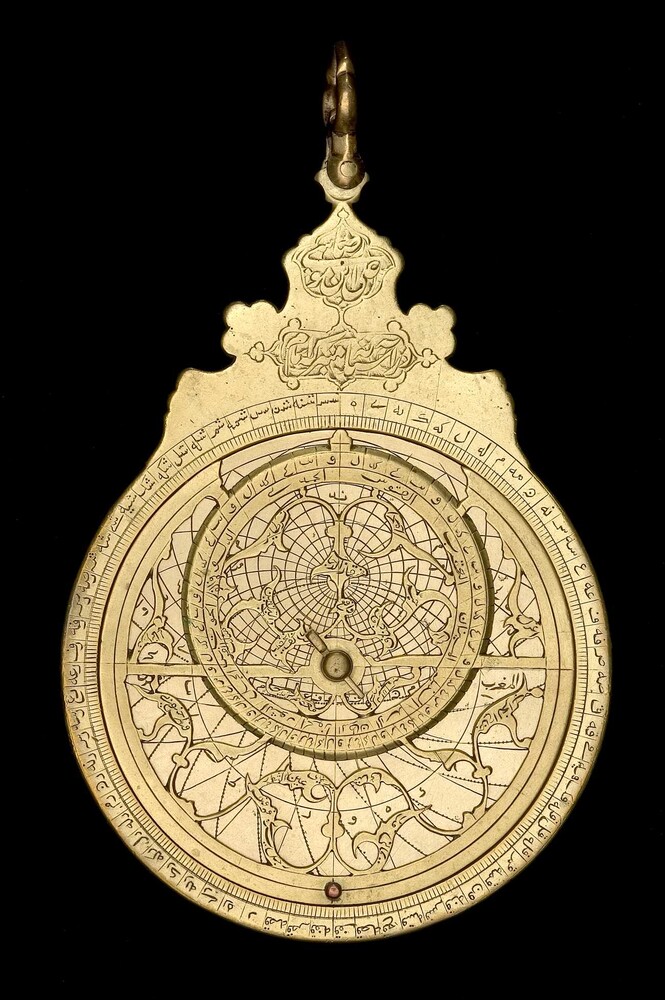 Astrolabe, by Ibrahim ibn Sharaf ad-din Husayn, Persian, 1641Inventory Number 43148
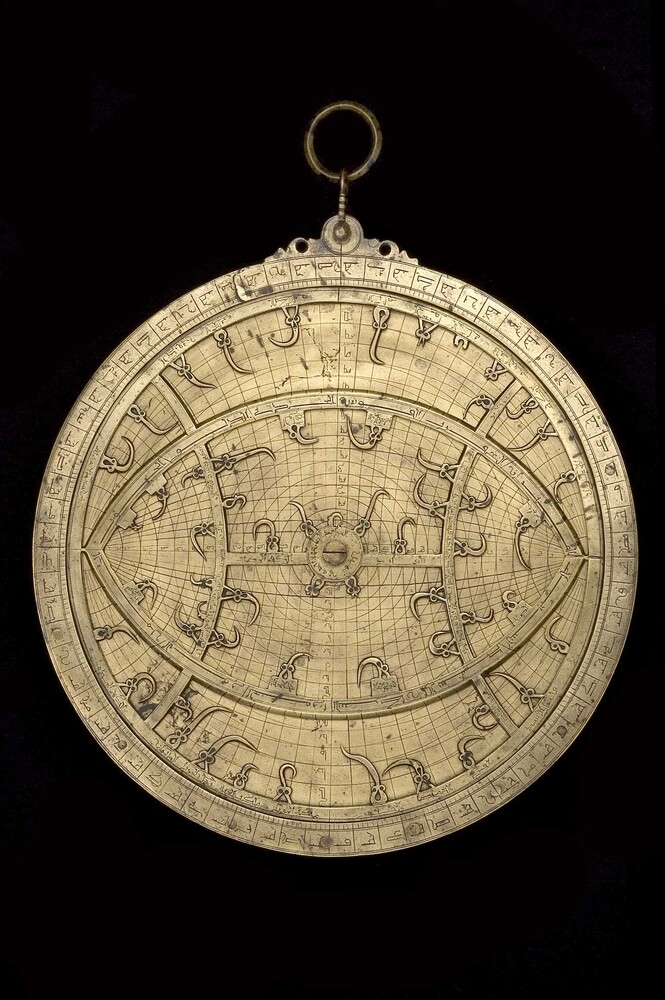 Astrolabe with Universal Lamina, by `Ali ibn Ibrahim al-Harrar, Taza, Morocco, 1327/8Inventory Number 50853
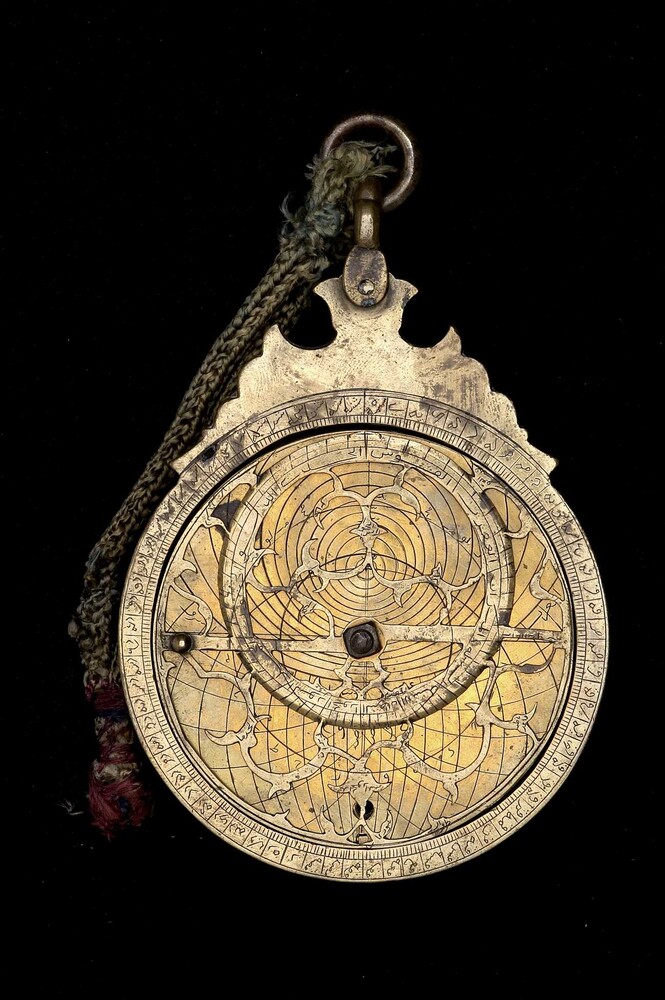 Astrolabe, by 'Ibn Muhibb Haqiqa, Indo-Persian, 1647/8Inventory Number 52066
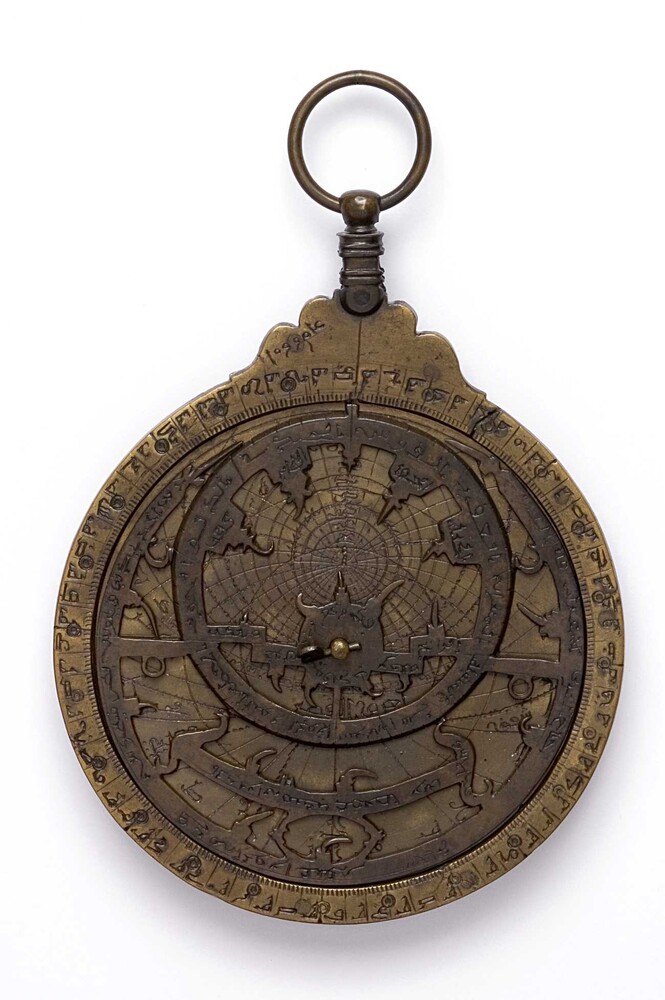 Astrolabe, by Adbullah ibn Sasi, North African, 1687/8Inventory Number 45220