- Brief Description
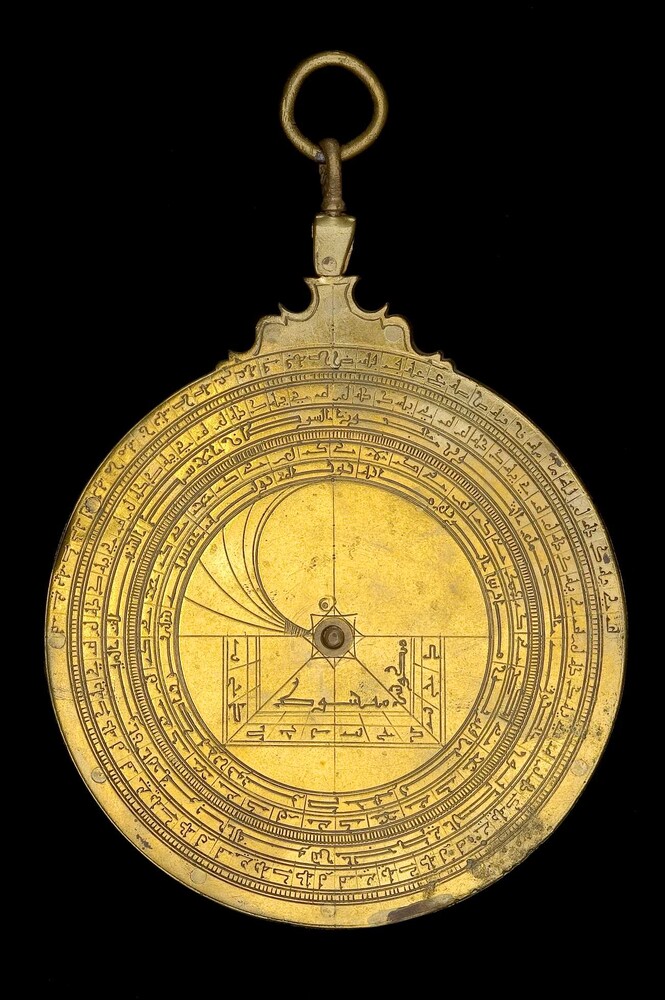
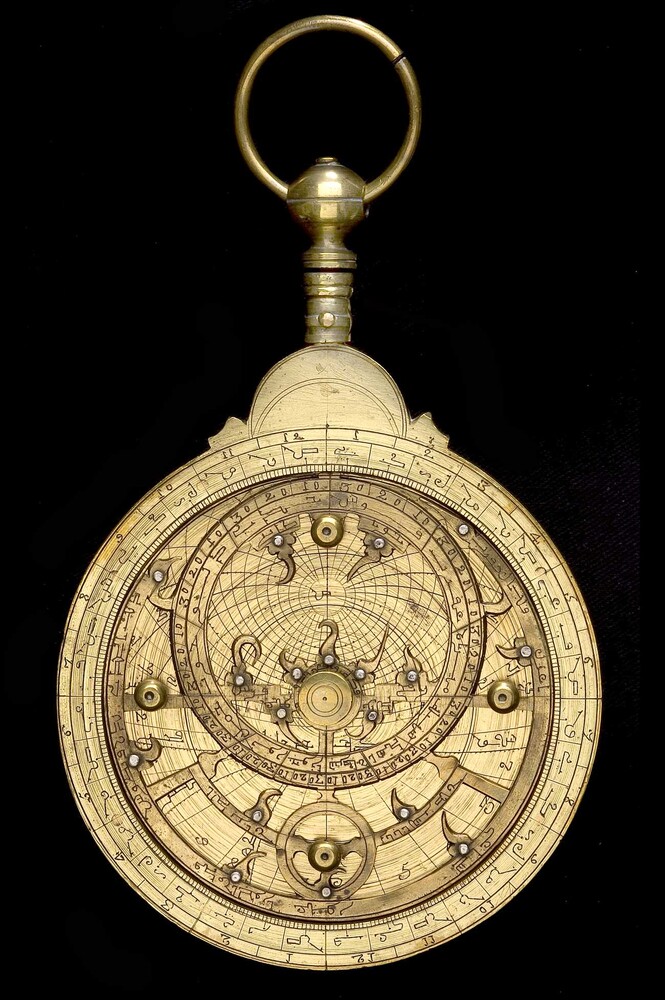
- This small astrolabe was made in Andalusian Spain or North Africa probably in the 1300s CE. It features silver studs on the bases of all its star pointers as well as notches around the scales on the rim showing that the maker's concern was to allow easy usage of this astrolabe in poor lighting conditions. The silver would have made the star pointers shine while the notches would have allow the user to feel the correct degrees by hand.
- Subject
- Astrolabes
- Item type
- Object
- Provenance
- Presented by Lewis Evans. Purchased by him from Harding on 4 November 1894, who bought it at one of H. Weishaupt's sales at Puttick & Simpson's.
- Physical material
- Brass
- Object type
- Astrolabe
- Dimensions
- Height: 167mm Width: 133mm Depth: 33mm Weight: 0.55kg
- Inventory No
- 53556
- Accession Number
- 1924-0/part
Description
The front of the mater, the rete, and plates are inscribed in kufi script while the back features a more rounded form of naskh script.
Parts
It comprises: a mater, a rete for 28 stars, 5 plates, an alidade, a horse and pin. With leather case.
Throne
The throne is of small size. It is engraved deeply on the front looking almost pierced, and features a light engraving on the back. It is attached with a integrated base.
Ring
The ring is part of the shackle mechanism and it has a square section.
Shackle
Shackle of the eye-bolt type
Mater
The mater and limb are of two pieces, soldered construction. The notch that accepts the tabs from the tympans is located at the throne. The rim is marked with an altitude scale 0-360°, divided every 5 degrees, subdivided every degree, and labelled in Abjad numerals every 5 degrees.
Womb
The womb is blank.
Back
The back contains: two altitude scales on the upper half of the rim 0-90°, divided and notched every 5 degrees, subdivided every degree and labelled every 5 degrees in Abjad numerals; a zodiacal calendar divided in 30 degrees and labelled every 5 degrees in Abjad numerals on top of each sign; a Julian calendar also divided in 30 degrees and labelled every 5 degrees on top of each month; arcs of unequal hours in the upper-left quadrant; a shadow square in the central lower half divided into 4 fingers with no markings.
Rete
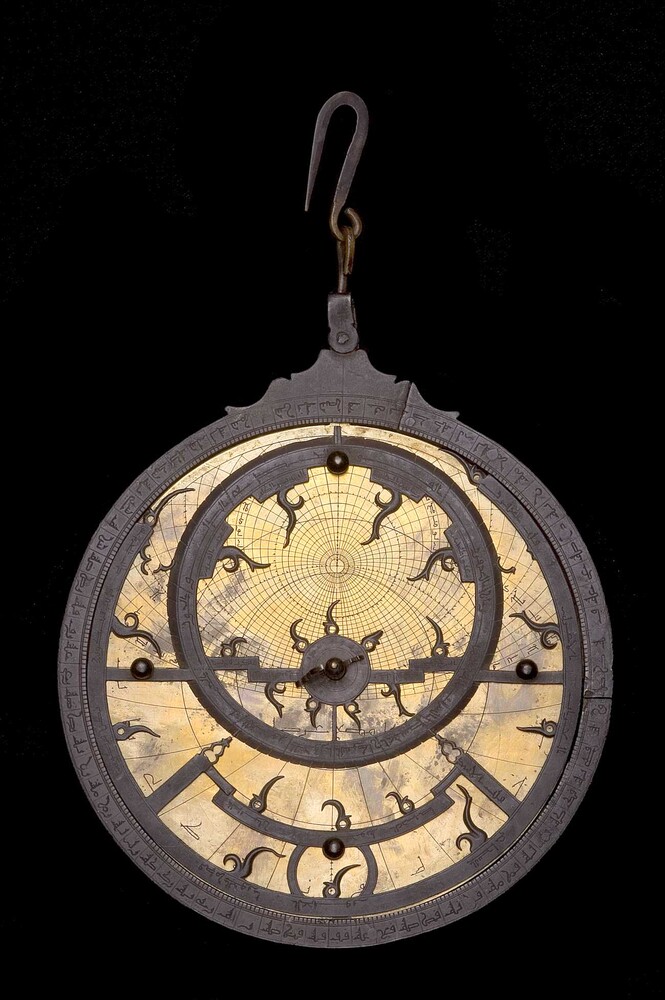
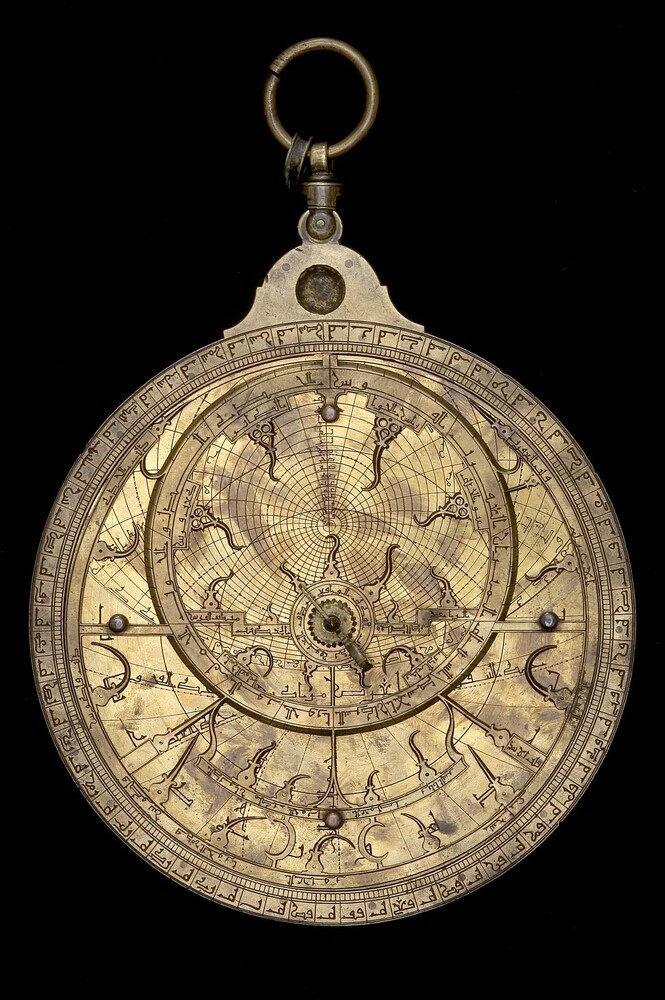
The rete is of the Maghrebi type with hook star pointers with silver rivets at the bases (one is missing). There are 6 silver knobs for rotation. It features 28 stars.
Zodiac label
The zodiac on the rete is labelled: الحمل , الثور , الجوزا , السرطان , الاسد , السنبله , الميزان , العقرب , القوس , الجدي , الدلو , الحوت.
Pin and horse
The pin is attached to a round bracket that pivots on the throne.
Alidade
Double-ended, decorated by three lines engraved down its length.
Plates
There are 5 plates for latitudes 21°, 24°, 30°, 33°, 36°, 42° and 45° and including a plate engraved on one side as a tablet of horizons (of western type) and on the other for latitude 0°. Almucantars are given for every 6 degrees and labelled in Abjad numerals. Azimuths are given for every 10 degrees and labelled in Abjad numerals. East and West are marked المشرق and المغرب.