- Brief Description
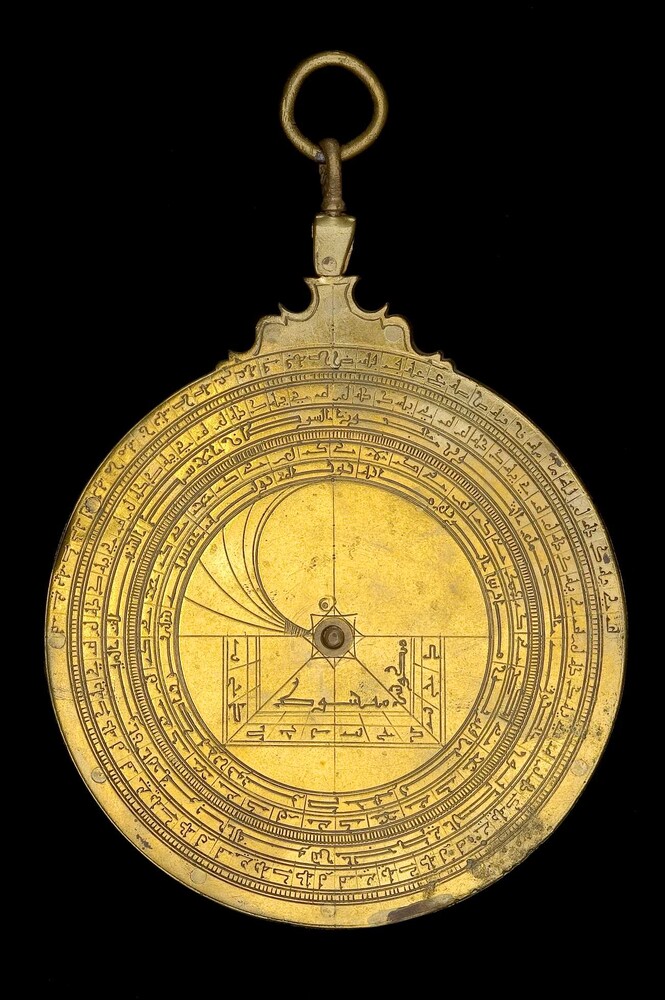
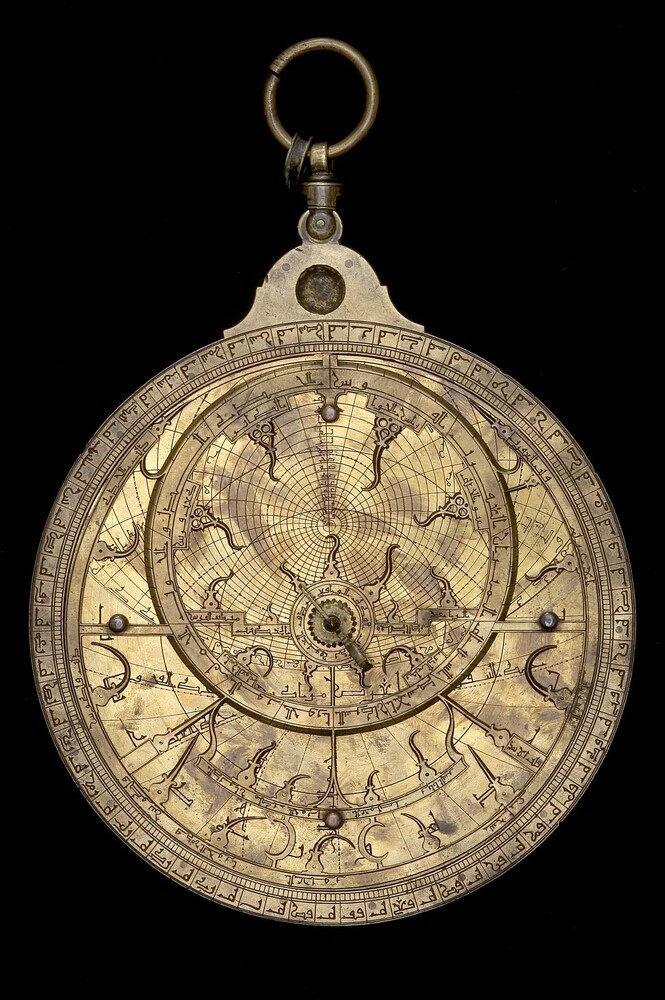
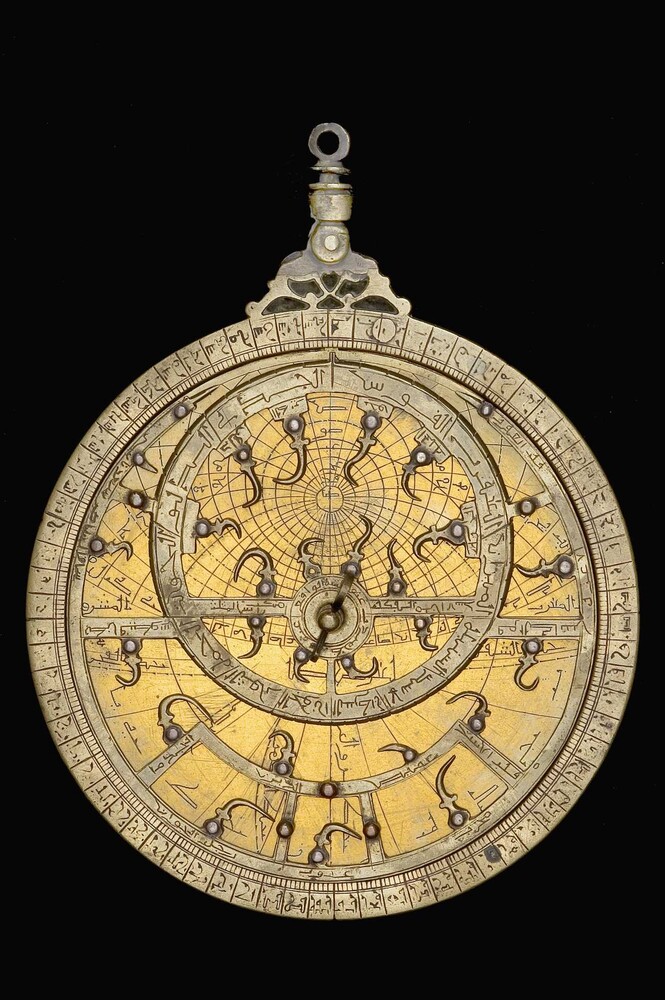
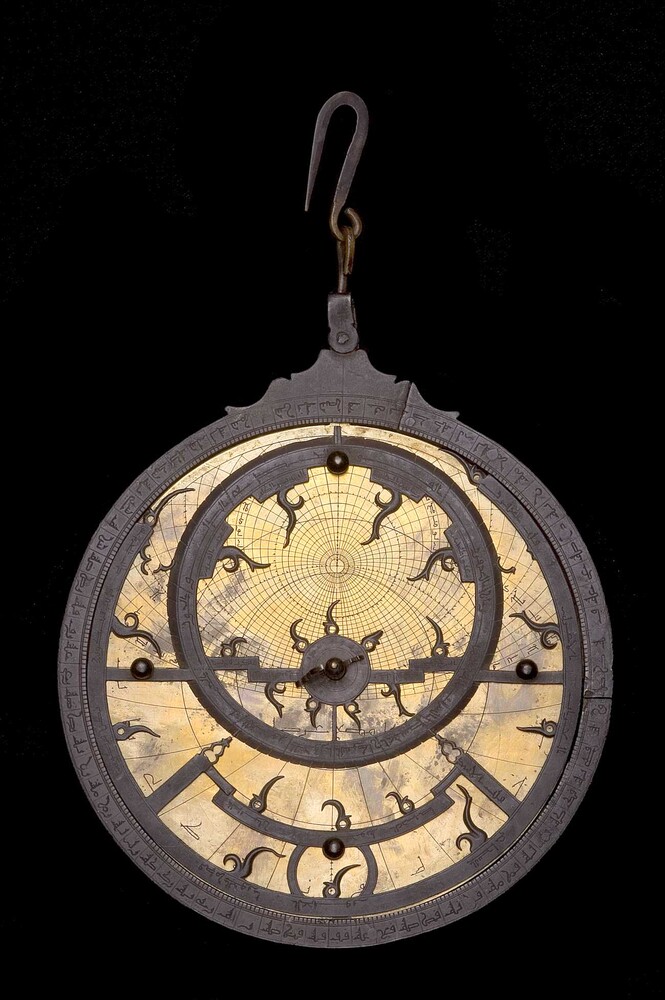
- Instrument makers in North Africa continued to make astrolabes well into the nineteenth century. The rete to the right reflects a number of features common to western instruments. The back of the rete features the word "PATENT", punched on it in a 1800 style of lettering. This indicates that the rete was cut from a sheet of brass formerly used for some other purpose, possibly coming from Victorian Britain where such lettering reading PATENT are found on metal objects. Another unusual feature of this astrolabe is the limb, engraved both with a scale of degrees and a scale of equal hours. A further peculiarity is the clarity of its Arabic numerals written in the maghrebi style, from which European numerals derive. These can be seen in the back and on the plate and are easily recongnisible as they look like Latin numerals.
- Subject
- Astrolabes
- Item type
- Object
- Provenance
- Presented by Lewis Evans. Bought by Lewis Evans from Percy Webster in 1916.
- Physical material
- Brass
- Object type
- Astrolabe
- Dimensions
- Diameter: 123mm Height: 212mm Width: 28mm Weight: 0.6kg
- Inventory No
- 47714
- Accession Number
- 1924-0/part
Description
Parts
It comprises: a mater, a rete, 3 plates, an alidade, a screw pin.
Throne
The throne is of the simple type and it is attached with a integrated base. A large single lobe is flanked by two small, simple scrolls.
Ring
The ring is of the simple, round cross-section type (i.e. simple plain ring made from a round rod or piece of metal). A large, undecorated ring.
Shackle
Shackle of the rotating pin type (i.e. pin with a 'ball-joint' on the end). This shackle is a large rotating pin through which the ring passes. The base of the pin attaches to the throne by means of a pivoting pin. The shackle is a development of the type of shackle found on the later maghribi astrolabes such as that on by Muhammad b. Ahmad al-Battuti of 1728-9 CE (51459).
Mater
The mater and limb are of two pieces, soldered and riveted construction. The notch to hold the tympans in place is located at the throne. The rim is marked with a degree scale 0-360° divided every 10 degrees, subdivided every 5 degrees, further divided every degree, and labelled in Abjad numerals every 10 degrees. A second scale of equal hours runs around the outer edge divided 1-12 on each half and labelled in Western Maghrebi numerals.
Womb
The womb contains circular scratches and is otherwise undecorated.
Back
On the back are engraved a scale of degrees, a shadow square, a diagram of unequal hours, and a zodiac/calendar scale (0° Aries = 7 March; concentric type).
Rete
The rete is of the Maghrebi type with hook star pointers with silver rivets at their bases. There are 4 knobs for rotation. It features 18 stars. The silver studs cover over some of the letters, indicating that they were added to the rete after the words had been engraved. The word "PATENT" is punched on the back of the rete, showing that the rete was engraved on a reused, possibly Victorian, English brass plate.
Zodiac label
The ecliptic circle is divided and labelled in Maghrebi numerals every 10 degrees. The zodiac is labelled: حمل , ثور , جوزا , سرطان , اسد , سنبله , ميزان , عقرب , قوس , جدي , دلو , حوت.
Pin and horse
The rete is attached using a nut and bolt. Round-headed bolt and nut.
Alidade
Double-ended. Some simple scroll-work on each side of the pivot hole, else undecorated.
Plates
There are 3 plates for, "Mecca and [?] 21. 40", "Country of the Sudan 26"; "Medina the noble 25. 30", "Tangier and Qasr [al-Kabir] 35"; "Marrakesh and Alexandria 31. 30", "Fez, Meknes and Rabat 34".