
- Item type
- Object
- Makers
- Henry G. Moseley
- Primary inscriptions
- In pencil on reverse 'For April Phil Mag/ The High-Frequency Spectra of the Elements/Part II/H.Moseley/48 Woodstock Rd/Oxford'
- Dimensions
- Height: 240mm Width: 387mm
- Inventory No
- 14674
- Accession Number
- 1964-95
Description
Mock-up of apparatus diagram for article 'The High Frequency Spectra of the Elements Part II' by Henry Moseley, featured on page 704, 'The most convenient type of X-ray tube is drawn to scale in fig.1.' Moseley generally drew-up his own diagrams and was an excellent draughtsman.
The diagram and publication were an output of experiments conducted by Henry Moseley, first at Manchester in 1913 and then at Oxford from November 1913 to the summer of 1914. He studied chemical samples using X-ray spectroscopy and hence determine their atomic number. The results were published in the ‘Philosophical Magazine’ in 1913 and 1914.
Moseley used X-rays to analyse the properties of elements in a new and brilliant way: he generated characteristic X-rays of sample elements and analysed them in the spectrometer. Moseley placed the specimens he wanted to investigate in an X-ray tube and created a vacuum by evacuating air from the X-ray tube and spectrometer. He made use of the effect that when an element is bombarded with energetic electrons X-rays with characteristic wavelengths are produced. These different wavelengths led to the X-rays being reflected at different angles from the crystal in the centre of the spectrometer. So when X-ray beams of different wavelengths hit a photographic plate they will create distinct lines. The angular position and separation of these lines are unique for each element. These values helped Harry to determine the wavelengths of the lines and hence the number of protons in the element’s nucleus.
See attached narrative 'Henry 'Harry' Moseley and his experiments' for further details.
Related Items
More related items- Trolley Apparatus for Target Samples, by H.G.J. Moseley, Manchester/Oxford, c.1913Inventory Number 22996
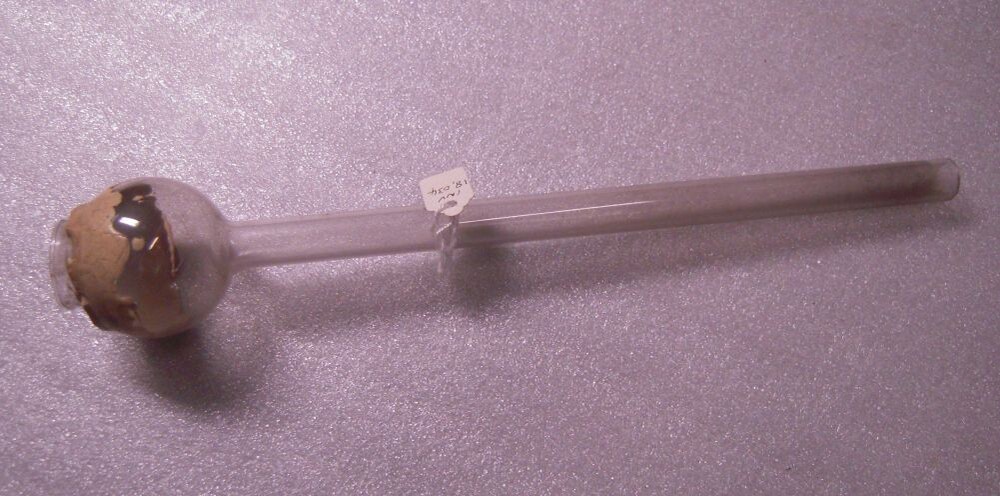 Glassware Piece from Moseley Apparatus, Manchester/Oxford. c.1913Inventory Number 18034
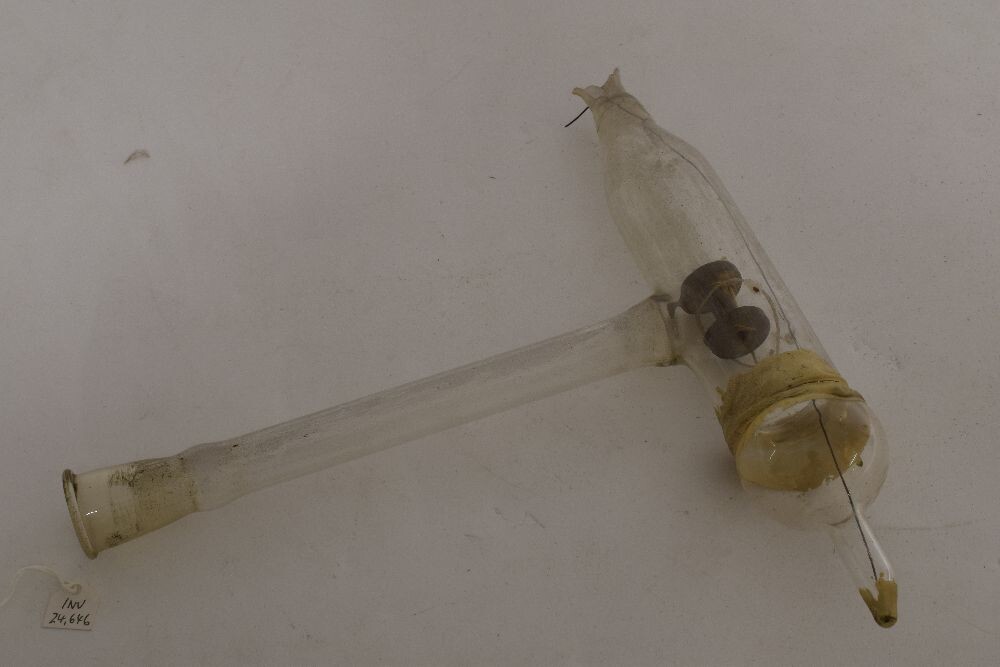 Spare Tube Apparatus with Trolley Bobbin, by H.G.J. Moseley, Manchester/Oxford, c.1913Inventory Number 24646
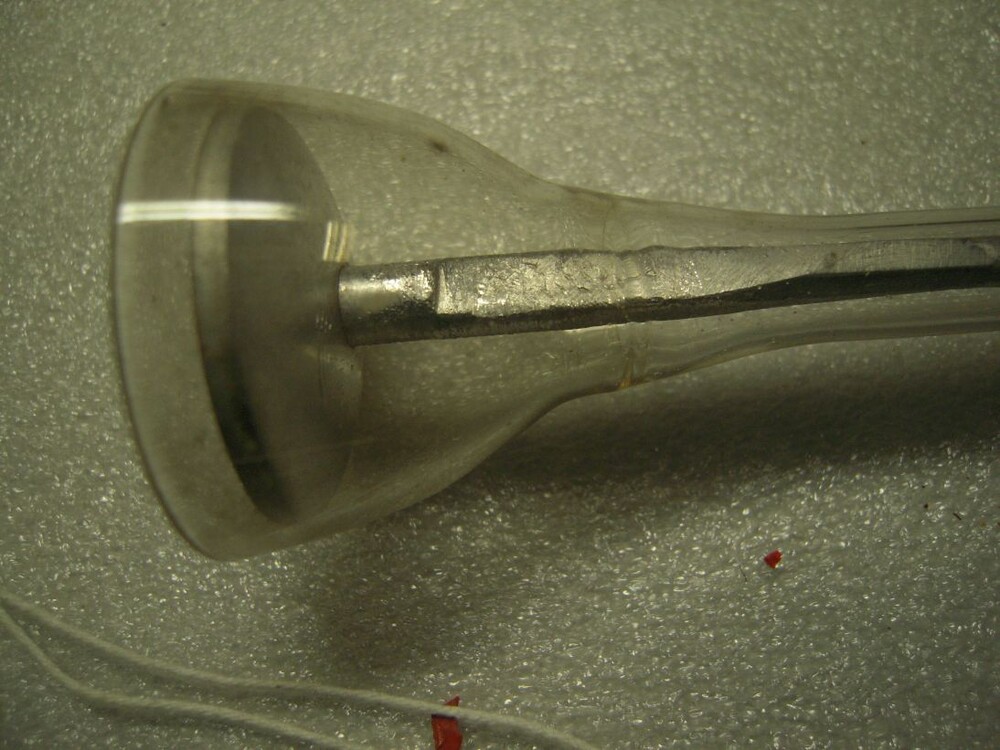 Trial Electrode from Moseley Apparatus, Manchester/Oxford, c.1913Inventory Number 28749