
- Subject
- Microscopy
- Item type
- Object
- Provenance
- Lent by the Royal Microscopical Society in 1970. Bequeathed to the Society by Eliot Merlin in 1948
- Primary inscriptions
- "Powell & Lealand. 170 Euston Road, London. 1892" on the arm
- Object type
- Microscope
- Inventory No
- 10706
Description
Monocular compound Microscope, by Powell and Lealand. The limb of this copper alloy instrument is carried on trunnions on a tripod. The body tube is mounted on an arm attached to a triangular sectioned bar that can be racked up from within the limb for coarse focusing. A graduated screw on the arm adjusts the fine focus. There are three body tubes the largest of which has a draw tube moved by a rack and pinion. Eyepieces push into the top of the body and objectives screw into a cylinder below the arm. Slides are held by a sprung bracket that slides on the mechanical stage plate. The sub stage assembly can be aligned and focused. The Plano-concave mirror is mounted on a sliding sleeve on the lower end of the limb.
The microscope is stored in a mahogany cabinet with internal glass panel, allowing the case to act a display cabinet. The case has three drawers that hold accessories. The accessories are an eyepiece micrometre on a telescoping stand with a circular lead-weighted base, thirty five objectives in cans, two empty cans, seventeen eyepieces, nine collars, a frosted glass disc in a collar, a double objective changer, three nose fittings,, two achromatic condensers with rotating aperture discs (one is in position beneath the stage), a nicol prism polarizer, condenser with three quarter wave discs on a swinging column, dark ground illuminator, parabolic condenser, a 'Formula 3' condenser by Nelson, condensing lens in rectangular plate, dark ground condenser, seven funnel shaped stops, 10 dark ground stops (6 of which are stored in a can), a lens in a can, a specimen chamber on rectangular base, a glass square in a can, and a cylindrical leather case.
Related Items
More related items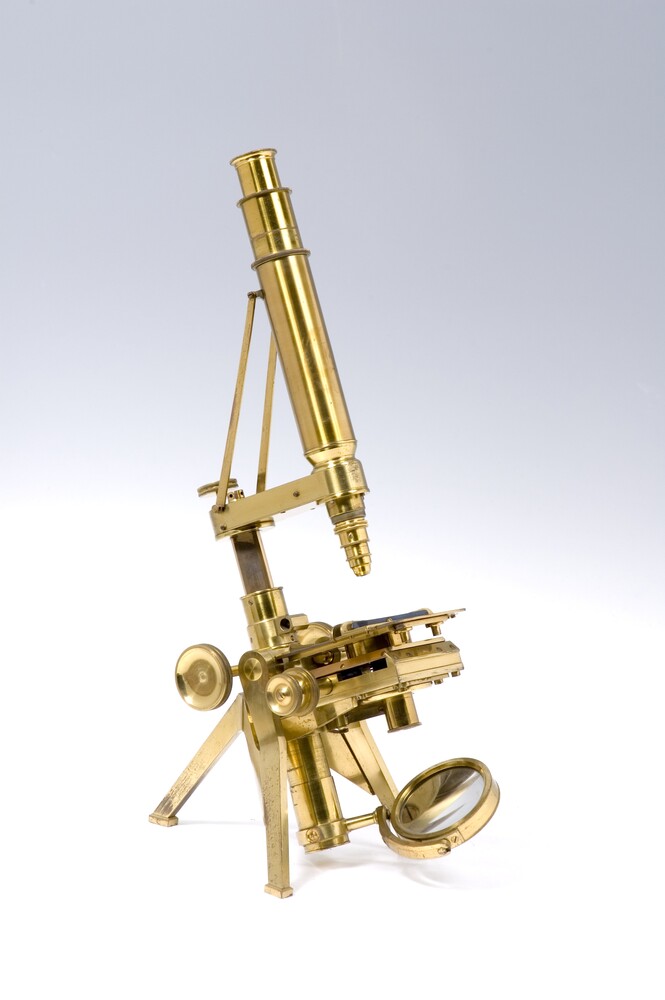 Monocular Microscope with Accessories and Case by Powell and Lealand, LondonInventory Number 10297
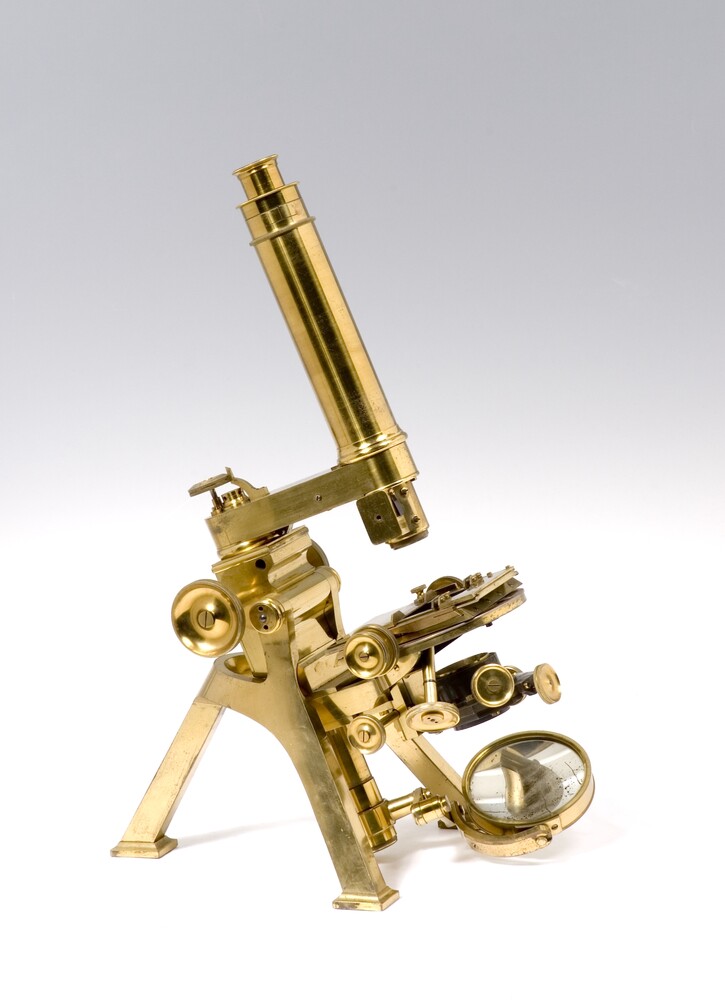 Compound Microscope with Accessories in Case, by Powell & LealandInventory Number 10243
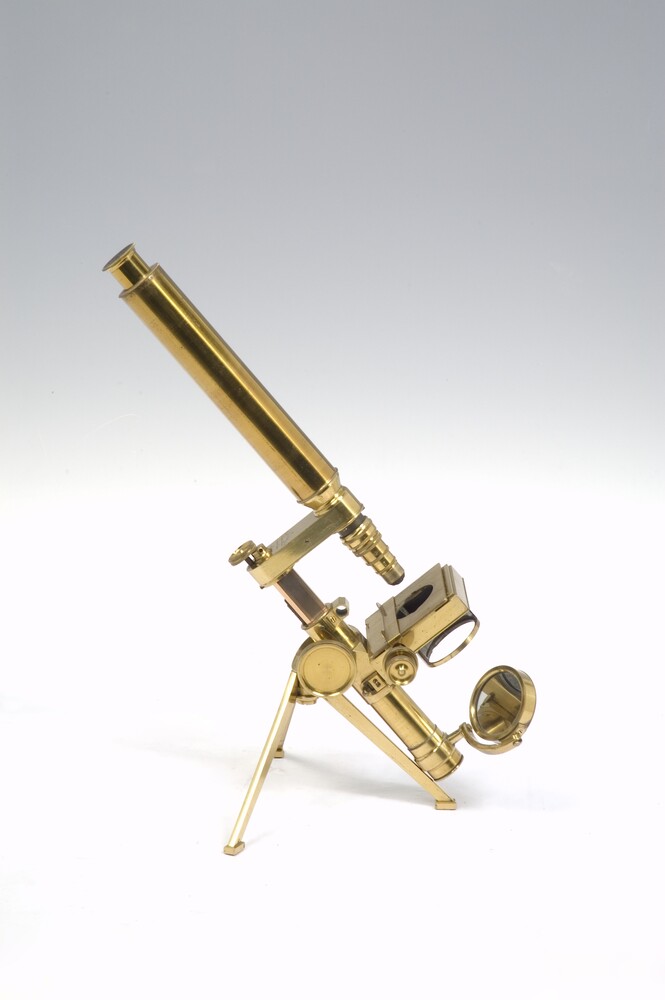 Compound Microscope and Accessories in Case, by Powell and Lealand, London, 19th CenturyInventory Number 53493
- Compound Microscope in Case with Accessories, by Powell & Lealand, London, 1864Inventory Number 37352