- Brief Description
- This astrolabe belongs to the production of the famous Lahore workshop of which we know only through the signatures on a group of objects, of which this belongs. The workshop was established by Allahdad in the mid-1500s CE, and who signs a couple of astrolabes (see for example 47376). This astrolabe is signed by one of his grandsons. He gives his name on this astrolabe as "Qaim Muhammad bin Isa bin Allah-Dad Humayun's astrolabist of Lahore". Like his brother Muhammad Muqim, Qaim Muhammad used the phrase "Asturlabi Humayuni Lahuri" to describe his grandfather. We do not know whether the family worked directly for the emperor or the court or whether their signature simply means that Allah-Dad lived at the time of the Emperor Humayun. What is certain is that both brothers attempt to make a clear connection with the emperor. Here, Qaim Muhammad dates this astrolabe as belonging to "year 8 from the accession of Shah Jahan", the Mughal Emperor reigning at the time.
- Subject
- Astrolabes
- Item type
- Object
- Makers
- Muhammad Muqim
- Provenance
- Presented by Lewis Evans. It was bought by Evans from Fenton in Cranbourne St., in September 1921.
- Primary inscriptions
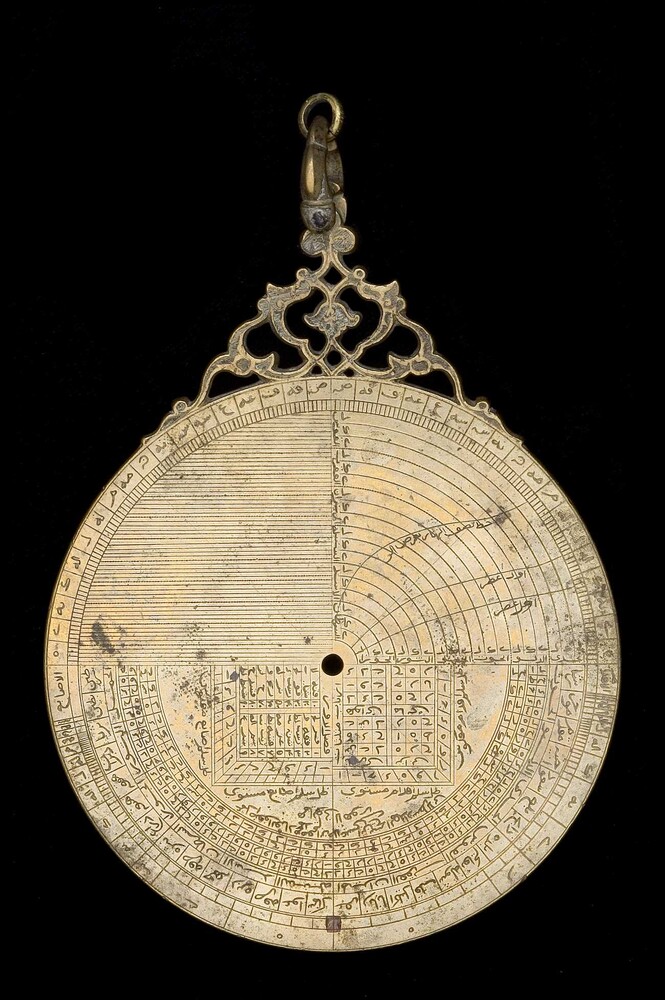
- صنعت أقل العباد قائم محمد ابن عيسى ابن الهداد اصطرلابي لاهوري همايوني "Work of the least of the servants Qa'im Muhammad bin 'Isa bin Allah-Dad (or Ilah-Dad) Humayun's astrolabist of Lahore". Engraved on the back of the rete. سنة ١٠٤٤ جهان "Hijri year 1044". Engraved within the shadow-square on the right. سنة ٨ جلوس شاه جهان "Year 8 from the accession of Shah Jahan". Engraved in the shadow-square, on the left. سنة رومي ١٩٤٦ "Rumi year 1946". Engraved at the side of the shadow square on the right.
- Physical material
- Brass
- Object type
- Astrolabe
- Dimensions
- Height: 308mm Width: 194mm Depth: 62mm Weight: 3.2kg
- Inventory No
- 42730
- Accession Number
- 1924-0/part
Description
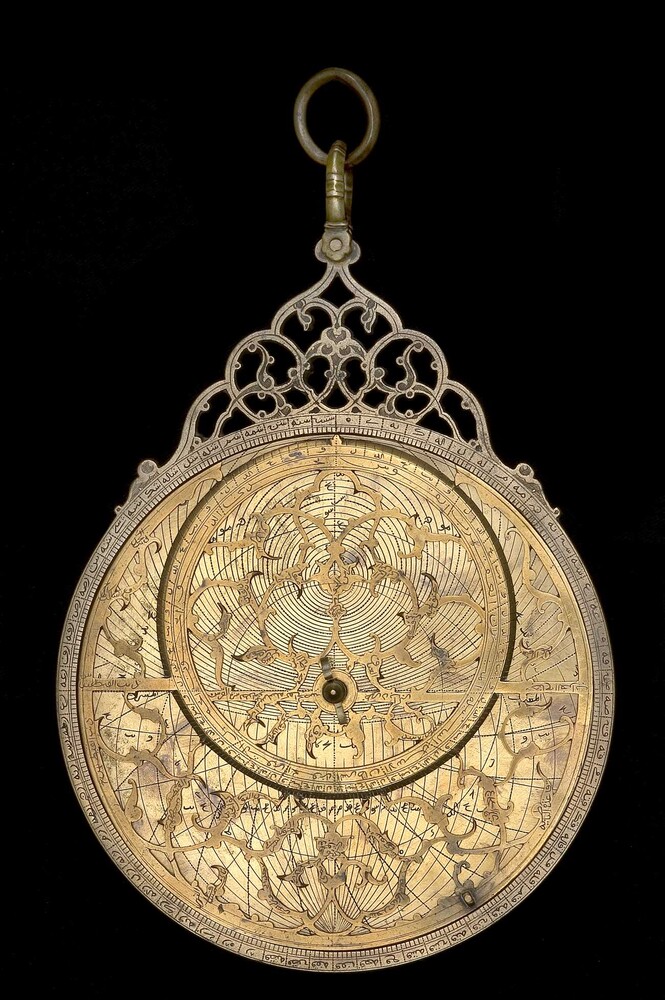
The high triangular throne is ornamentally pierced and decorated with engraving, and is characteristic of Mughal astrolabes.
Parts
It comprises: a mater, a rete, 7 plates, an alidade, a horse and pin.
Throne
The throne is of the indo-persian, pierced type and it is attached with a integrated base. As with many pierced Indo-Persian thrones, the lattice work is decorated with foliate engravings.
Ring
The ring is of the simple, squared cross-section type (i.e. a simple ring made from a round rod or piece of metal).
Shackle
Shackle of the trefoil type.
Mater
The mater and limb are of one-piece construction. The tab to hold the tympans in place is located at the bottom of the instrument, 180° from the throne. The rim is marked with a degree scale 0-360° divided every 5 degrees, subdivided every degree, further divided every 1/2 degree, and labelled in Abjad numerals every 5 degrees.
Womb
The mater is engraved with a gazetteer of the longitudes and latitudes of 120 places, arranged according to 'climate'.
Back
On the back is a sine/cosine quadrant with arcs of the signs of the zodiac; a graph of the arcs of the signs, each sign divided into five divisions of 6 each, with a graph of the relation between the sun's right ascension and meridian altitude for latitude 32° (Lahore); a shadow-square, within which is a table of astrological triplicities; cotangent scales; an astrological table of the limits and faces of the planets; and, an unusual feature, a zodiac/calendar scale of the Syrian solar months (0° Aries = 113/4 Âdhâr; eccentric type) with a scale of the 28 astrological mansions of the moon.
Rete
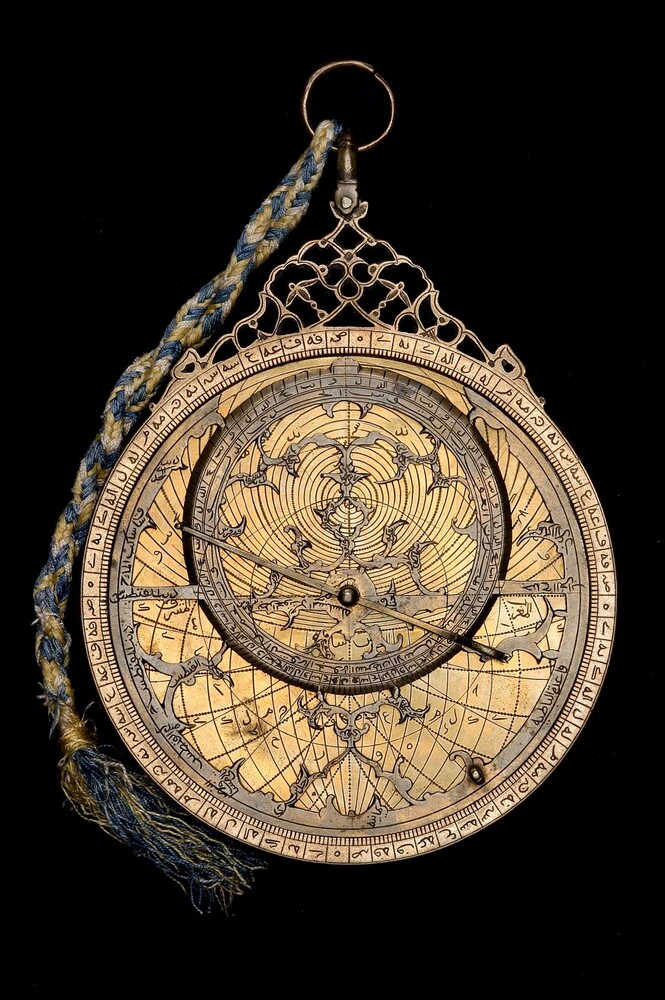
The rete is of the foliate type. The maker's signature is on the back. A very unusual feature of the rete is the inclusion in the centre of the foliate tracery, of a small zawraq or 'ship' rete, for use with the miniature tablet for 42°. It features about 50 stars.
Zodiac label
The ecliptic circle is divided every 6 degrees, subdivided every 2 degrees, and labelled in Abjad numerals every 6 degrees. The zodiac is labelled: الحمل , الثور , الجوزا , السرطان , الاسد , السنبله , الميزان , العقرب , القوس , الجدي , الدلو , الحوت.
Pin and horse
The rete is attached using a pin and horse. Both are undecorated.
Alidade
On the alidade are a declination scale corresponding to the arcs of the signs, a declination scale divided in degrees, and a scale of unequal hours. The sighting-vanes of the alidade are pierced with two holes.
Plates
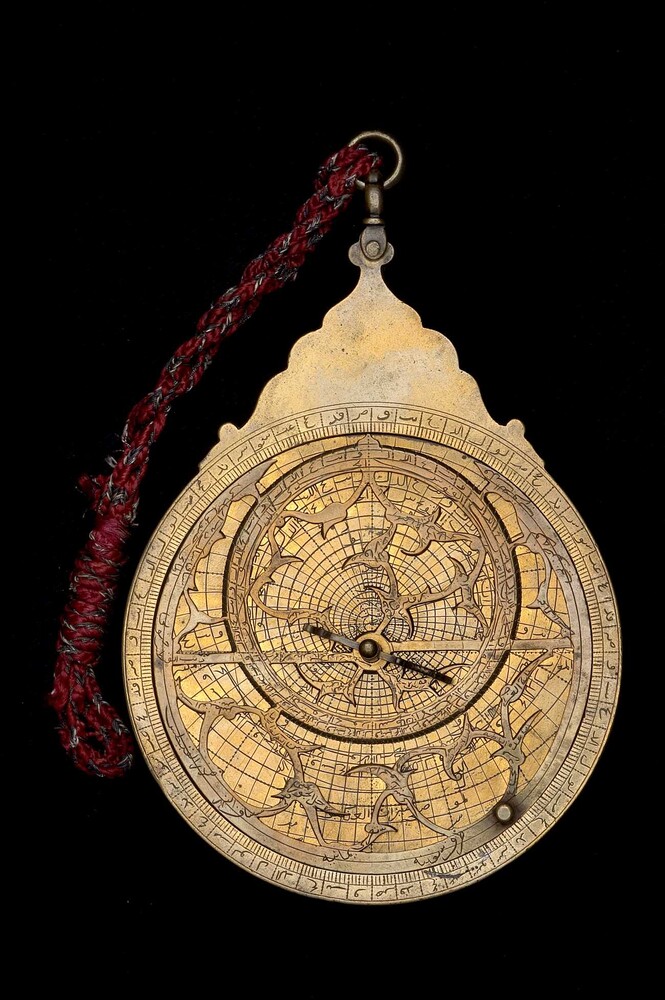
There are 7 plates: a) a double tablet for latitudes 0° and 90°, and a tablet of horizons (eastern type); b) for latitudes 18° and 42° (or 44°), and 38°; c) for latitudes 20° and 70°, and 23°30'; d) for latitudes 25°, and 30° and 36°; e) for latitudes 27° and 52°; f) for latitudes 35°, and 22° and 40°; g) a tablet of ecliptical co-ordinates, and a tablet (shown) of the 12 astrological houses, in the centre of which is a miniature tablet for 42° for use with the 'ship' in the centre of the rete. The plates are variously engraved with azimuths above and below the horizon line, and with the lines of Babylonian hours. The large number of seven double-sided plates with this astrolabe covers a very wide geographical range, though with the concentration of latitudes in the 20s and 30s. Some of the plates are constructed with a pair of latitudes on a single face. These composite plates include one for the equator and the pole (that is, 0° and 90°)