- Brief Description
- This astrolabe belongs to the production of the famous Lahore workshop of which we know only through the signatures on a group of objects, of which this belongs. The workshop was established by Allahdad in the mid-1500s CE, and who signs a couple of astrolabes (see for example 47376). This astrolabe is signed by one of his grandsons. He gives his name on this astrolabe as "Muhammad Muqim ibn Isa ibn Allahdad Humayun's astrolabist of Lahore" with some very slight variations from the other signatures of the same maker (37530). Like his brother Qa'im Muhammad, Muhammad Muqim used the phrase "Asturlabi Humayuni Lahuri" to describe his grandfather. The phrase might mean no more than that Allahdad worked in the time of the emperor Humayun, but the family may have intended and would certainly have preferred the more prestigious interpretation that Allahdad was the emperor's own astrolabist. Humayun was certainly reported to have "an extraordinary interest and proficiency in the astrolabe". A peculiarity of this astrolabe is the presence of multiple dates, likely added by successive owners.
- Subject
- Astrolabes
- Item type
- Object
- Makers
- Muhammad Muqim
- Provenance
- Presented by J. A. Billmeir with his collection.
- Primary inscriptions
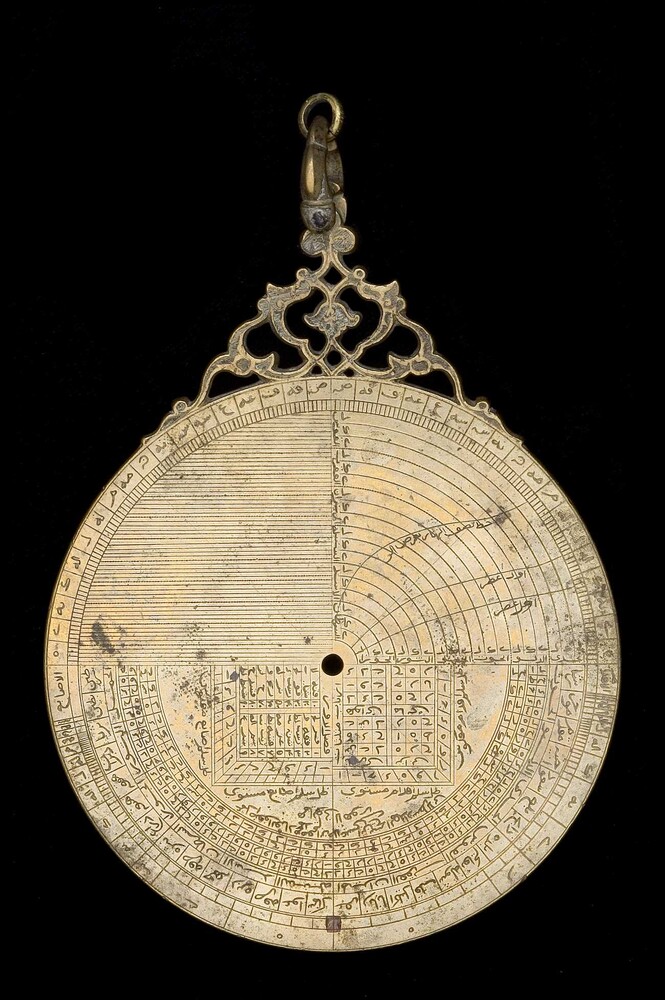
- صنعت أضعف العباد محمد مقيم ابن عيسى ابن الهداد اسطرلابي همايوني لاهوري "The work of the least of the servants Muhammad Muqim ibn `Isa ibn Allah-dad Humayun's astrolabist of Lahore". Engraved on the back in a circle below the central hole. في سنة ١٠٥١ هجرية "In the year 1051 of the Hijra". Engraved below the shadow-square.
- Object type
- Astrolabe
- Dimensions
- Diameter: 129mm
- Inventory No
- 46935
- Accession Number
- 1957-84/160
Description
Parts
It comprises: a mater, a rete, 4 plates, a horse and pin, a silk cord (`ilaqa).
Throne
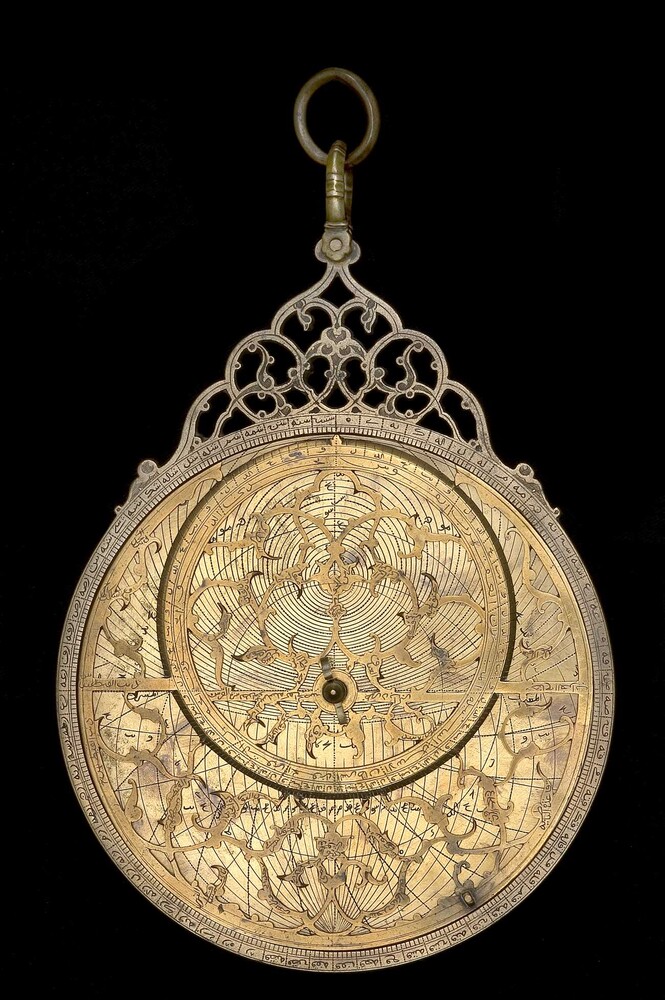
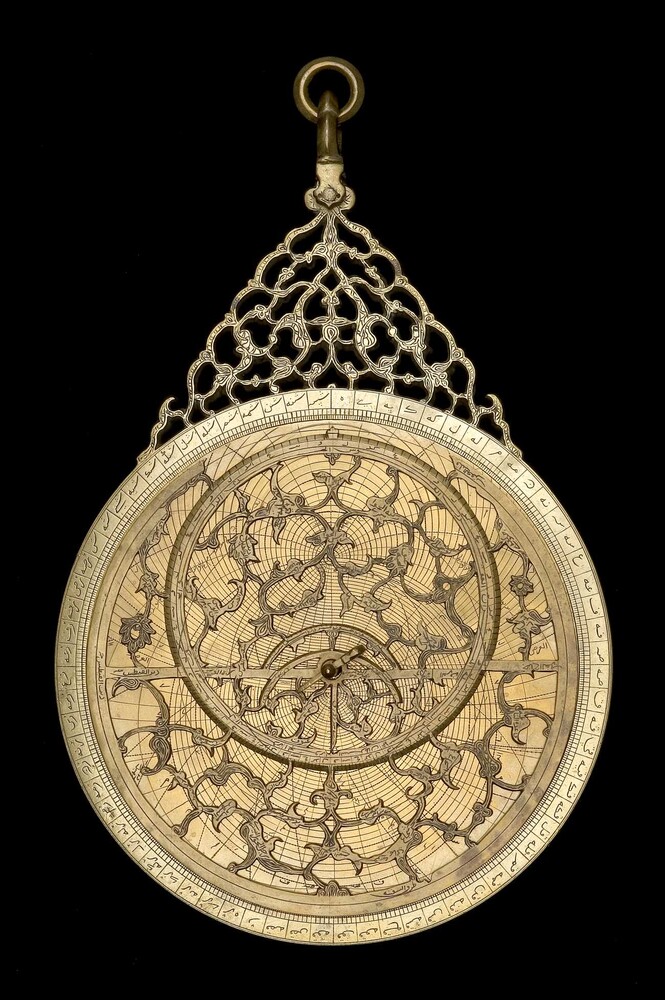
The throne is decoratively pierced as is common on Indo-Persian astrolabes.
Ring
The ring is of the simple, round cross-section type (i.e. simple plain ring made from a round rod or piece of metal). The joint has not been soldered together.
Shackle
Shackle of the trefoil type.
Mater
The rim is marked with a degree scale 0-360° divided every 5 degrees, subdivided every degree, and labelled in Abjad numerals every 5 degrees.
Womb
The womb is engraved as a gazetteer of the longitude and latitude of ?? cities.
Back
On the back are a sine/cosine quadrant, the arcs of the signs of the zodiac with the sigmoid graphs, diagnostic of Indian astrolabes, showing the relation between the sun's right ascension and meridian altitude for latitudes 22° and 32°; a shadow-square, within which is an astrological table of the 28 mansions of the moon and the signs of the zodiac; cotangent scales; an astrological table of the signs of the zodiac giving the limits of the planets; and the usual scales of degrees.
Rete
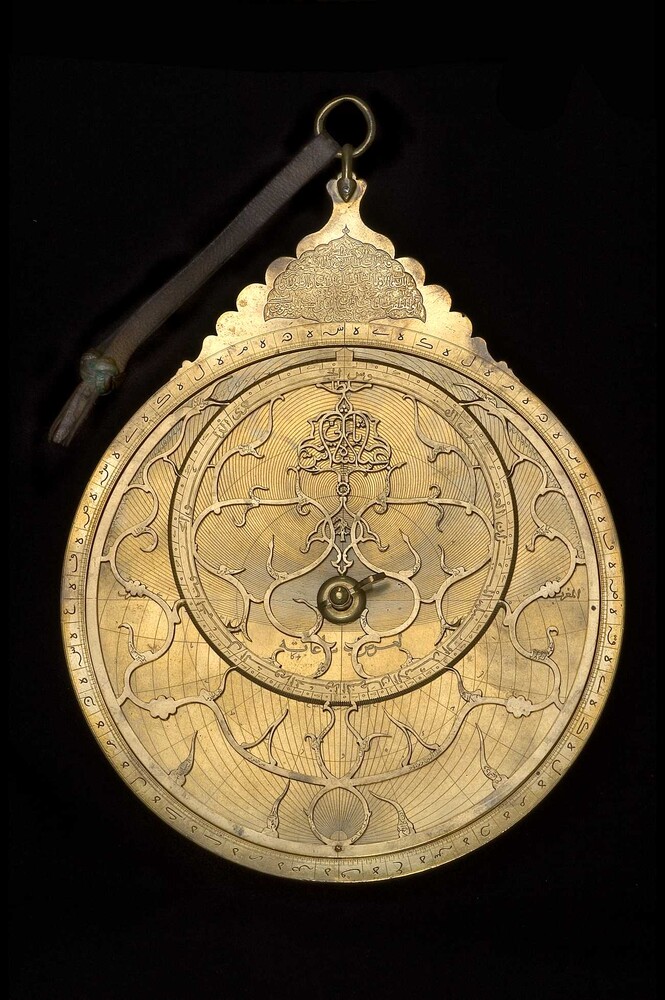
The rete is of the foliate type. The east-west bar is counter-changed. There is a single knob for rotation. It features about 40 stars.
Zodiac label
The ecliptic circle is divided every 6 degrees, subdivided every 3 degrees, and labelled in Abjad numerals every 6 degrees. The zodiac is labelled: الحمل , الثور , الجوزا , السرطان , الاسد , السنبله , الميزان , العقرب , القوس , الجدي , الدلو , الحوت.
Pin and horse
The rete is attached using a pin and horse. They are both replacements.
Alidade
The alidade is a replacement. The sighting vanes of the alidade are pierced with two holes.
Ilaqa
There is a plaited ilaqa (a loop of cord or leather used for suspending the astrolabe, when, as on many Persian instruments, the suspension ring is of too small diameter for the insertion of the user's thumb) of blue, yellow and white silk.
Plates
4 plates (perhaps originally five): 22°, 25°; 27°, 32°; 36°, 40°; tablet of co-ordinates of the ecliptic, tablet of horizons; all the plates for different latitudes are engraved with the usual almucantars, horizon, meridian, and unequal hour lines, but azimuths (above and below the horizon), Babylonian hours and Italian hours are variously included on the plates. In the mater is a circular table of the longitudes and latitudes of 69 places.