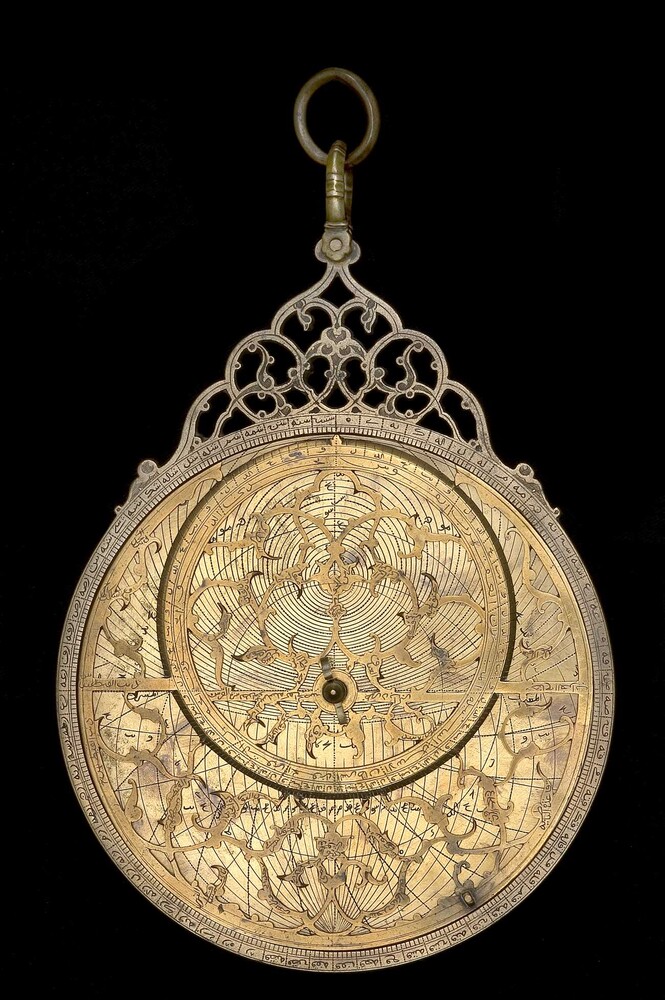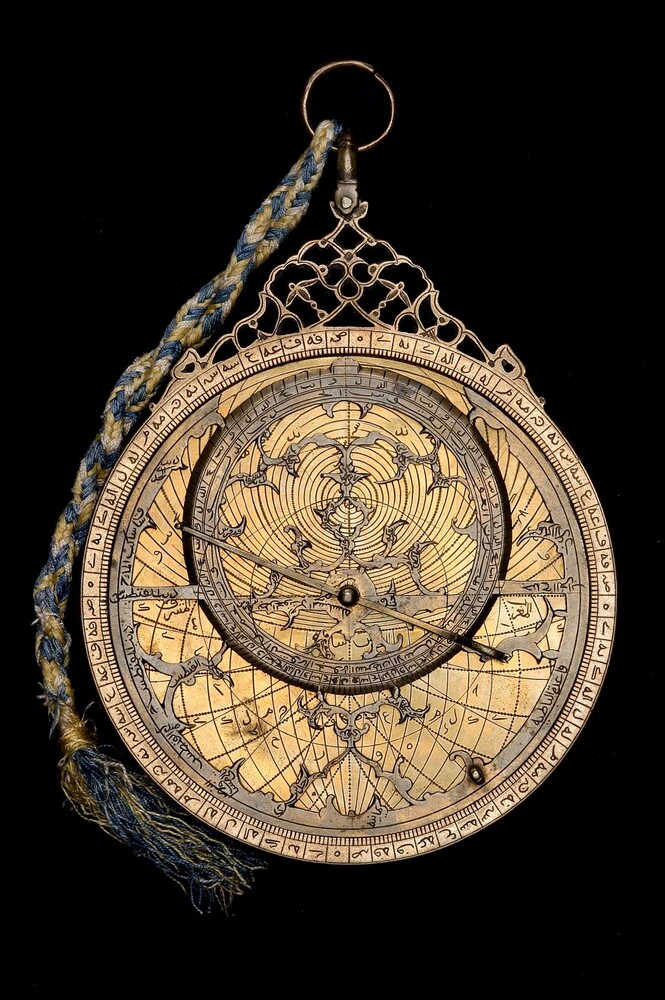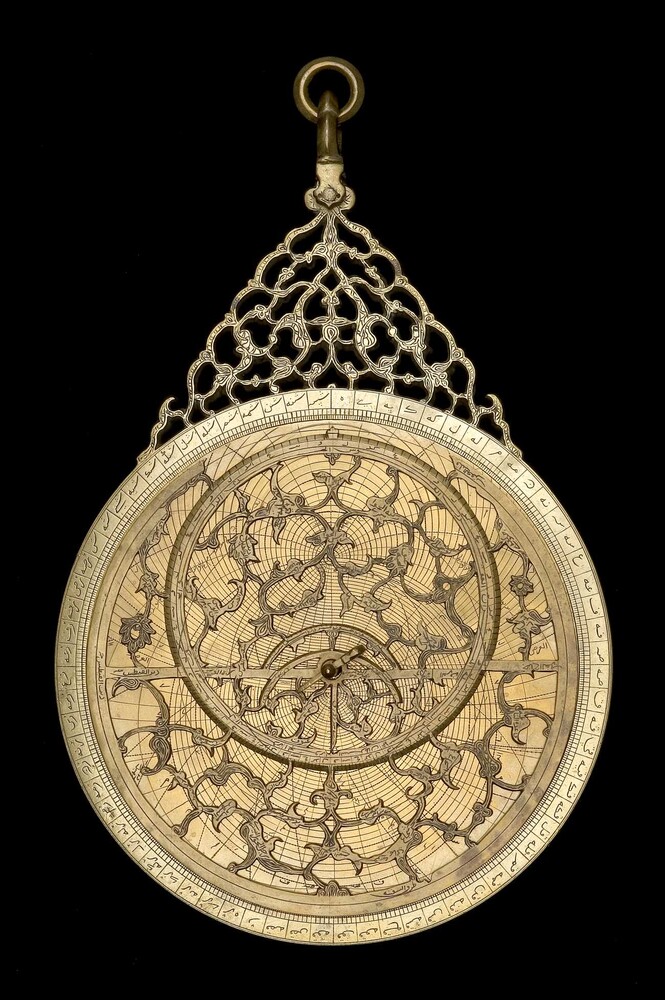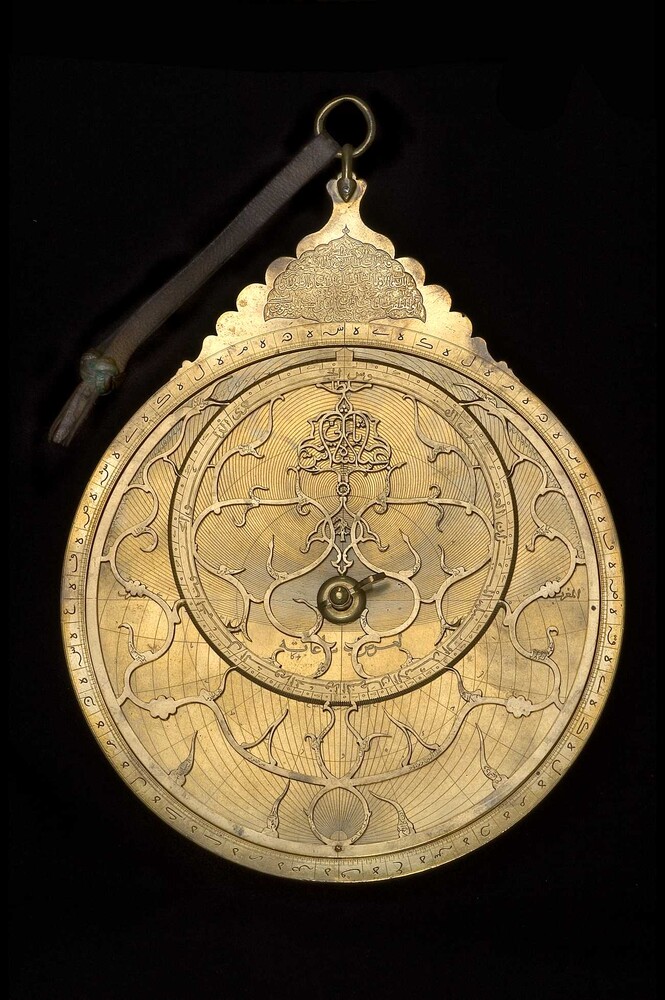
- Brief Description
- This astrolabe belongs to the production of the famous Lahore workshop of which we know only through the signatures on a group of objects, of which this belongs. The workshop was established by Allahdad in the mid-1500s CE, and who signs a couple of astrolabes (47376). This astrolabe is signed by one of his grandsons. He gives his name on this astrolabe as "Muhammad Muqim ibn Mulla `Isa ibn Shaikh Alhdad, Humayun's astrolabist of Lahore", with some very slight variations from the other signatures of the same maker (43704). Like his brother Qa'im Muhammad, Muhammad Muqim used the phrase "Asturlabi Humayuni Lahuri" to describe his grandfather. The phrase might mean no more than that Allahdad worked in the time of the emperor Humayun, but the family may have intended and would certainly have preferred the more prestigious interpretation that Allahdad was the emperor's own astrolabist. Humayun was certainly reported to have "an extraordinary interest and proficiency in the astrolabe".
- Subject
- Astrolabes
- Item type
- Object
- Makers
- Muhammad Muqim
- Provenance
- Presented by J. A. Billmeir.
- Primary inscriptions
- عمل أضعف العباد محمد مقيم ابن ملا عيسى ابن شيخ الهداد ،اسطرلابي همايوني لاهوري "The work of the weakest of the servants Muhammad Muqim ibn Mulla `Isa ibn Shaikh Alhdad, Humayun's astrolabist of Lahore". Engraved below the shadow-square.
- Physical material
- Brass
- Object type
- Astrolabe
- Dimensions
- Diameter: 130mm
- Inventory No
- 37530
- Accession Number
- 1957-84/3
Description
The alidade and the horse are missing.
Parts
It comprises: a mater, a rete, 5 plates, a pin.
Throne
The throne is of the indo-persian, pierced type and it is attached with a integrated base. The throne culminates in a trefoil.
Ring
The ring is of the simple, round cross-section type (i.e. simple plain ring made from a round rod or piece of metal). The inner edge of this ring is flat.
Shackle
Shackle of the trefoil type. The bottom of this trefoil is open.
Mater
The mater and limb are of one-piece construction. The tab to hold the tympans in place is located at the bottom of the instrument, that is 180° from the throne. The rim is marked with a degree scale 0-360° divided every 5 degrees, subdivided every degree, and labelled in Abjad numerals every 5 degrees.
Womb
The womb is engraved as a gazetteer of the longitude and latitude of 77 cities.
Back
On the back are scales of degrees; cotangent scales; a sine quadrant; the arcs of the signs with a graph showing the relation between the sun's right ascension and meridian altitude for latitude 27°, and graphs of the beginning and end of asr (used for determining the time of Muslim prayer); a shadow-square within which are a table of triplicities and a table of the differences between true and nominal years; and an astrological table of the signs of the zodiac, the terms and faces of the planets, and the mansions of the moon.
Rete
The rete is of the foliate type. The east-west band is counter-changed. It features about 42 stars.
Zodiac label
The ecliptic circle is divided every 6 degrees, subdivided every 2 degrees, and labelled in Abjad numerals every 6 degrees. The zodiac is labelled: الحمل , الثور , الجوزا , السرطان , الاسد , السنبله , الميزان , العقرب , القوس , الجدي , الدلو , الحوت.
Pin and horse
The horse is missing. A wing-nut replaces the horse.
Alidade
The alidade is missing.
Plates
There are 5 plates, for latitudes 22°, 25°; 27°, 32°; 36°, a composite tablet for 18° and 30°; 40°, a composite tablet for 45°, 72°, and 90°; and a tablet of horizons of eastern type and a tablet of ecliptical co-ordinates.