- Brief Description
- A fine example of an astrolabe belonging to the famous Lahore workshop. This astrolabe was made by the grand-son of the founder, Diya al-din Muhammad, who specialised in the making of celestial globes but also produced astrolabes.
- Subject
- Astrolabes
- Item type
- Object
- Makers
- Diya ad-din Muhammad
- Provenance
- Presented by Lewis Evans. Evans purchased it from Francis Vitali, Algeria, in July 1911.
- Primary inscriptions
- عمل أضعف العباد ضياء الدين بن القائم محمد ابن ملا عيسى ابن شيخ الهداد ،اسطرلابي همايوني لاهوري سنة ١٠٦٩ الهجرية "Work of the least of the servants Diya al-din ibn Qaim Muhammad ibn Mulla Isa ibn Shaikh Allah-dad Humayun's astrolabist of Lahore in the Hijri year 1069". Engraved within the shadow-square.
- Physical material
- Brass
- Object type
- Astrolabe
- Dimensions
- Height: 265mm Width: 179mm Depth: 42mm Weight: 1.5kg
- Inventory No
- 53637
- Accession Number
- 1924-0/part
Description
Parts
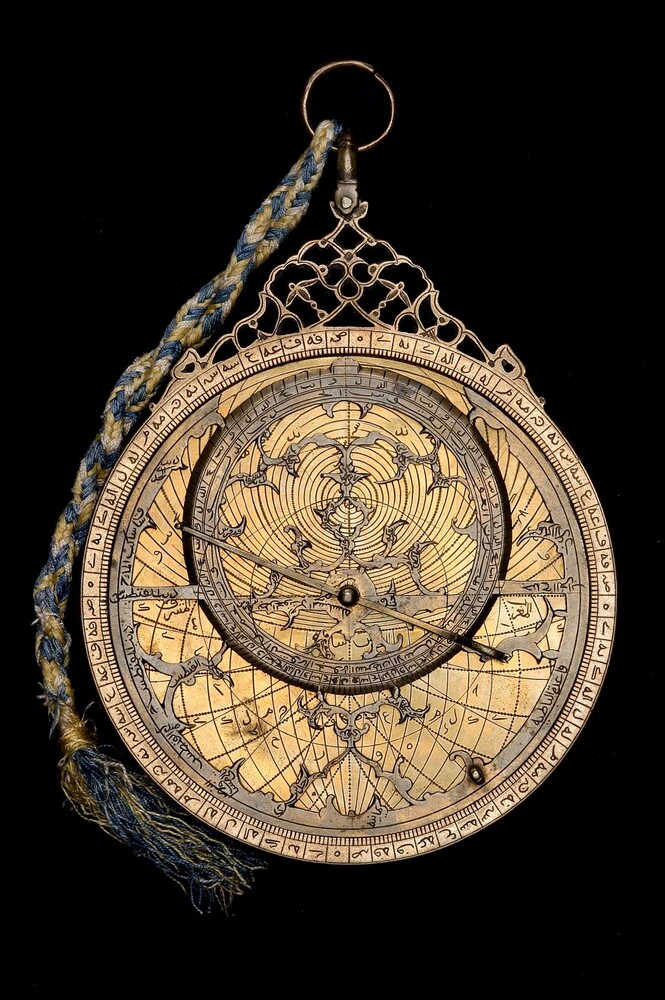
It comprises: a mater, a rete, 5 plates, an alidade, a horse and pin.
Throne
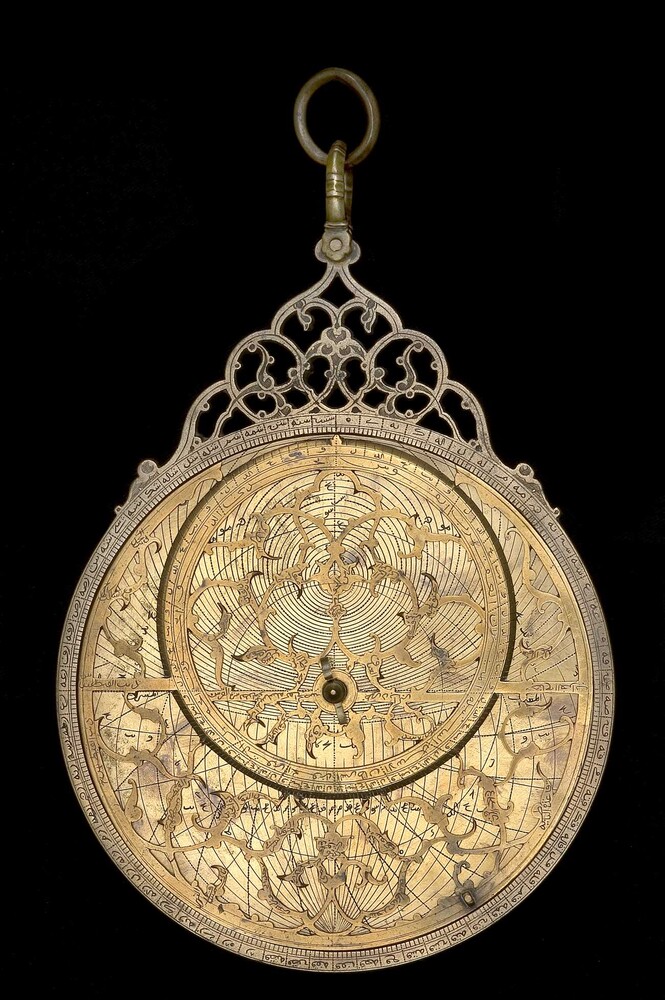
The throne is of the indo-persian, pierced type and it is attached with a integrated base. The center section of this throne is decorated with three large flowers.
Ring
The ring is of the simple, squared cross-section type (i.e. a simple ring made from a round rod or piece of metal).
Shackle
Shackle of the trefoil type. Attaches to the throne thorugh large, simple tabs.
Mater
The mater and limb are of one-piece construction. The tab is located at the bottom of the instrument, 180° from the throne. The rim is marked with a degree scale 0-360° divided every 5 degrees, subdivided every degree, and labelled in Abjad numerals every 5 degrees.
Womb
The womb is engraved with a gazetteer of the longitude and latitude of 89 places, arranged according to "climate".
Back
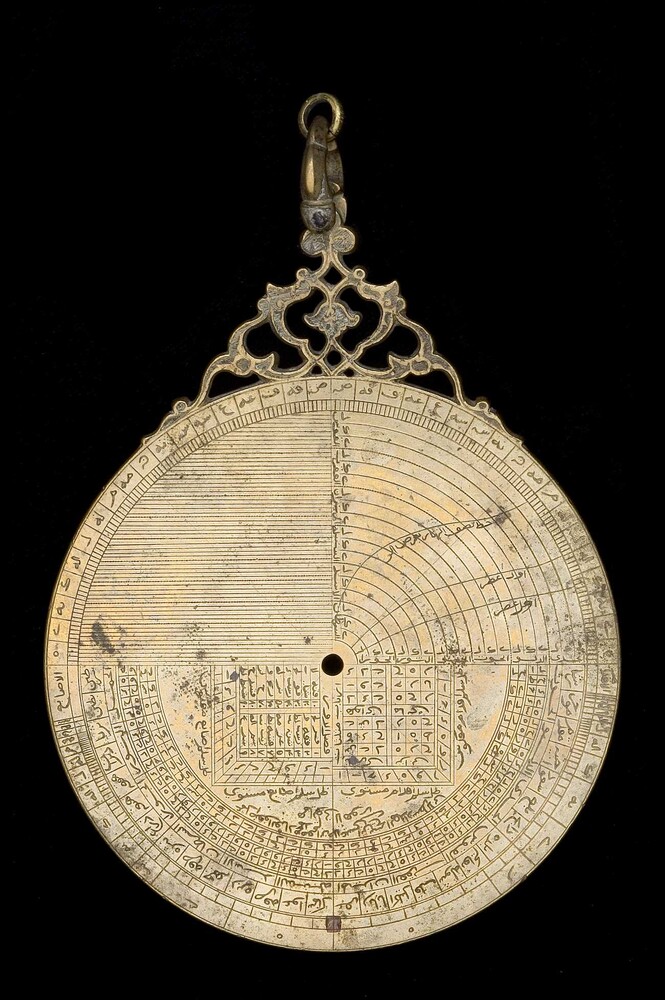
On the back are a sine-cosine quadrant; the arcs of the signs of the zodiac with graphs of the relation between the sun's right ascension and meridian altitude for latitudes 27°, 29°, and 32°; cotangent scales; an astrological table of the signs of the zodiac, the 28 mansions of the moon and the limits and faces of the planets; and a shadow-square within which are a table of astrological triplicities and a table of multiples of differences between the approximately correct length of the tropical year and 365 days.
Rete
The rete is of the foliate type. The east-west band is counter-changed. There is a single knob for rotation. It features 57 stars.
Zodiac label
The ecliptic circle is divided every 6 degrees, subdivided every degree, and labelled in Abjad numerals every 6 degrees. The zodiac is labelled: الحمل , الثور , الجوزا , السرطان , الاسد , السنبله , الميزان , العقرب , القوس , الجدي , الدلو , الحوت.
Pin and horse
he rete is attached using a pin and horse. The pin is undecorated; the horse is marginally more decorative, with its shaped tab.
Alidade
The alidade is engraved with a declination scale corresponding to the arcs of the signs of the zodiac, another declination scale divided in degrees, and a scale of unequal hours.
Plates
There are 5 plates, for latitudes 18°, 22°; 25°, 27°; 29°, 32°; 33°, and 35°; tablet of horizons of eastern type and tablet of ecliptical co-ordinates. The azimuths are drawn below the horizon, and there are lines representing Babylonian hours (and on one plate Italian hours also), in addition to the usual unequal hour-lines.