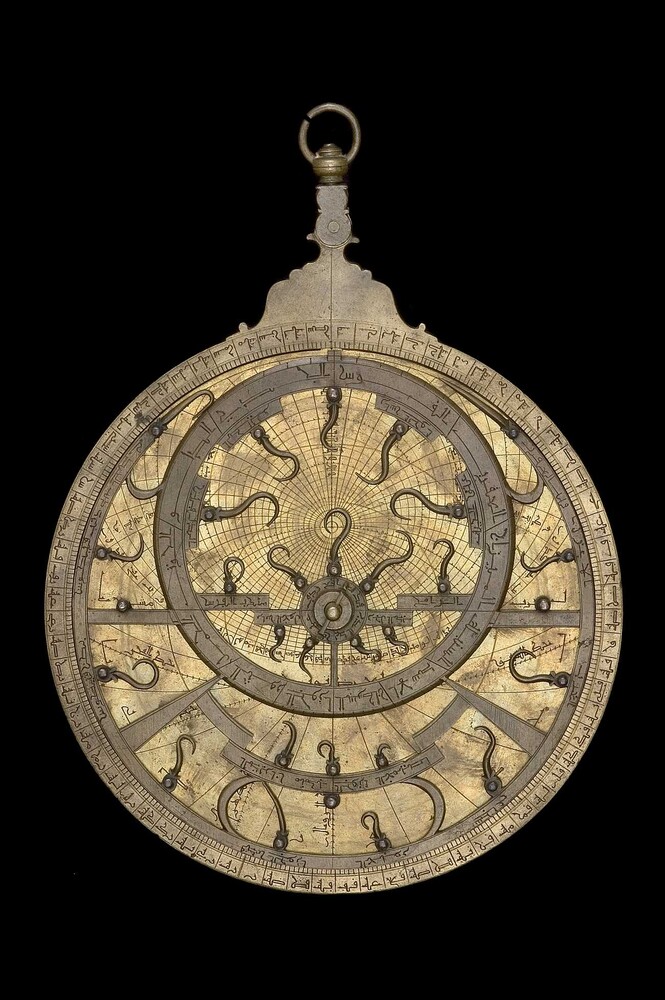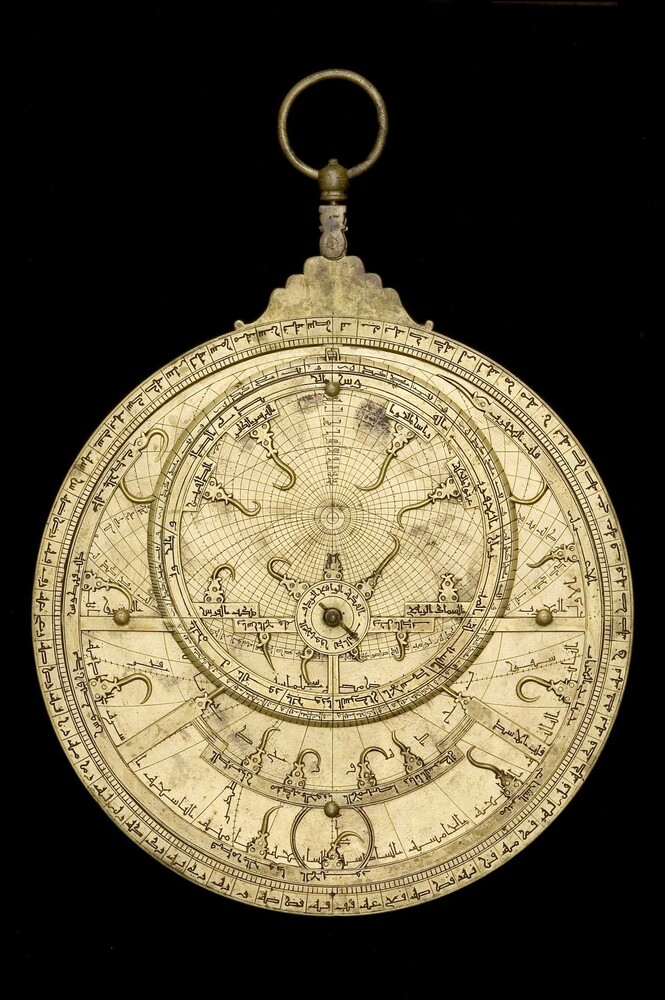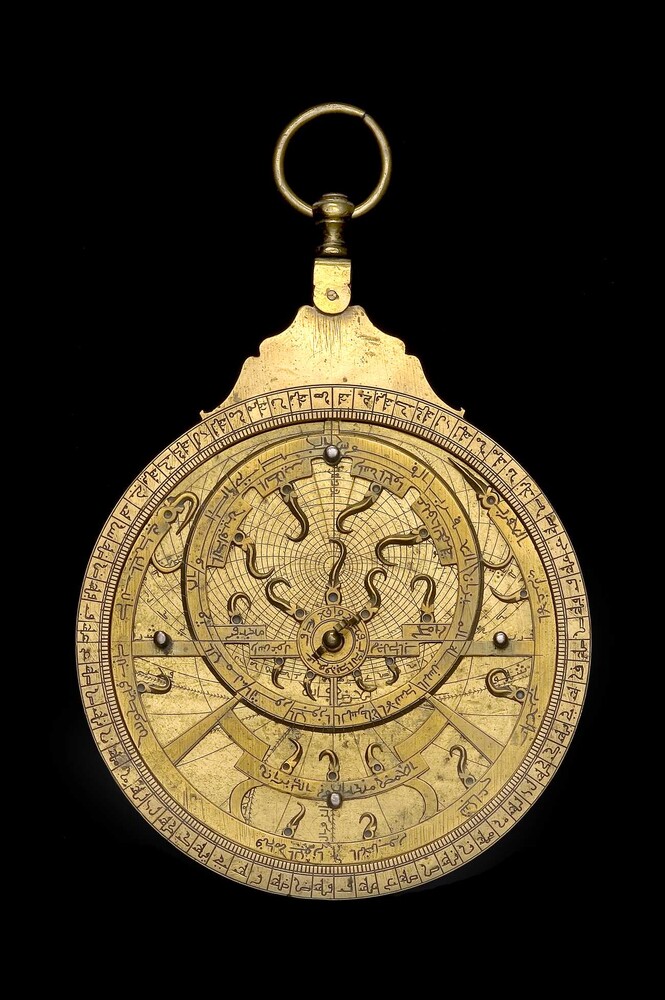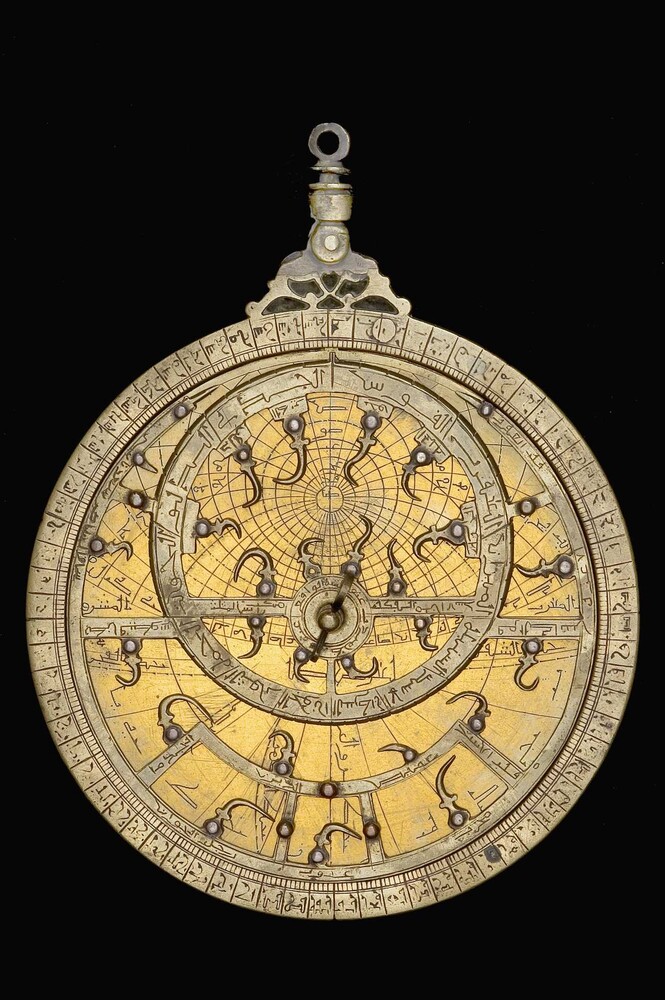
- Brief Description
- The unusual feature of this small astrolabe is the marking of the hours on the rim by small dotted circles. The maker of the astrolabe, is known as Abu-t-oayyib Abdallah bin Sa(tm)i al-falaki ("the astronomer"), a native of Safi in South Morocco. He is known as the author of an astronomical work completed in 1112 A.H. (1700-1 A.D.) so the date 1099 on the throne may reasonably be taken as the date of the instrument. One of the plates is engraved for latitude 32° which is that of Safi, the maker's birth-place. One of the plates is blank, featuring only the tropic and equator circles. This indicates that astrolabe were sometimes issued with blank plates in order to allow the owner to personalise them according to their own needs.
- Subject
- Astrolabes
- Item type
- Object
- Makers
- Adbullah ibn Sasi
- Provenance
- Presented by Lewis Evans Evans bought it from Webster (March 1918), who bought it through M. Gélis of Paris.
- Primary inscriptions
- الحمد لله! صنعة عبدالله بن ساسي غفر الله له و لوالده. "Thanks be to God! The workmanship of Abdullah the son of Sasi, may God forgive him and his father." Engraved on the back of the throne. ١٠٩٩ عام "1099". This is engraved in maghribî numerals on the front of the throne, but it is not certain that this indicates the date of manufacture.
- Physical material
- Brass
- Object type
- Astrolabe
- Dimensions
- Diameter: 124mm Height: 187mm Depth: 25mm Weight: 362g
- Inventory No
- 45220
- Accession Number
- 1924-0/part
Description
The marking and tables on the back are not very precisely engraved.
Parts
Mater; rete for 25 stars; alidade.
Throne
The throne is of the simple, engraved type and it is attached with a integrated base. The back of the throne bears the maker's inscription. The front of the throne bears the date 1099 in maghribi numerals.
Ring
The ring is of the simple, round cross-section type (i.e. simple plain ring made from a round rod or piece of metal).
Shackle
Shackle of the eye-bolt type (i.e. any shackle that attactes to the ring via an eye-bolt type feature).
Mater
The mater is broken on the limb in the upper right quadrant. On the limb there are small dotted circles markings the hours. The rim is marked with a degree scale 0-360° divided every 5 degrees, subdivided every degree, and labelled in Abjad numerals every 5 degrees.
Womb
The womb is blank.
Back
The back is engraved with scales of degrees, and shadow, a sine graph, and a zodiac/calendar scale (concentric type). There are two shadow scales, one of which is engraved in one of the quadrants and consists of two chords meeting the arc of the quadrant at an angle of 60°, with appropriate divisions, and marked "inverted shadow" and "extended shadow".
Rete
The rete is of the maghribi type with dagger-shaped star-pointers. The east-west band is counter-changed twice. The two knobs for rotation are now missing. It features 25 stars.
Zodiac label
The ecliptic circle is divided every 6 degrees. The zodiac is labelled: الحمل , الثور , الجوزا , السرطان , الاسد , السنبله , الميزان , العقرب , القوس , الجدي , الدلو , الحوت.
Pin and horse
The rete is attached using a pin and horse.
Alidade
Double-ended, original.
Plates
There are 2 plates, for latitudes 30°, 32° and 35°. One of the plates is only partially engraved on one side.