
- Brief Description
- A fine astrolabe, this instrument is inscribed as having been "given as a bequest" to the minaret of a mosque in Fez, showing it was likely meant to be used by the muezzin to calculate the hour of prayer. It features clearly marked lines for the calculation of Muslim prayer times, called prayer lines.
- Subject
- Astrolabes
- Item type
- Object
- Provenance
- Presented by J. A. Billmeir. Formerly in the Henri Michel Collection, Brussels
- Primary inscriptions
- الحمد لله وحده صنعه محمد بن أحمد البطوطي سنة ١١٤٦ "Praise to God alone. Made by Muhammad ibn Ahmad al-Battuti, A.H. 1146". Engraved on the back of the kursi. الحمد لله حبّس الرئيس الجليل الماجد الحفيل الفقيه الأجل سيدي محمد بن المرحوم بكرم الله تعالى القائم على ما ينبغي (؟) هذا الأصطرلاب على منار مولانا إدريس نفع الله به الذي بالحضرة الفاسية "Praise be to God. My master, the great, glorious, eager ruler, the greatest jurist, Muḥammad, son of the deceased, may God the Exalted have mercy with him, He, who establishes what is right (?), gave this astrolabe as a bequest [waqf] to the minaret of our master Idrīs, may God make use of him (for the benefit of others), which is in Fez." Engraved on the back, within hour-line diagram.
- Physical material
- Brass
- Object type
- Astrolabe
- Dimensions
- Diameter: 233mm Height: 322mm Depth: 52mm Weight: 1.5kg
- Inventory No
- 51459
- Accession Number
- 1957-84/13
Description
The plates are inscribed for the latitudes of Sigilmassa and Cairo (30°), Tunis (36°), Marrakesh (31°, 30'), and Meknes (34°). There is no plate for Fez itself, though the plate for Meknes could be used in its stead as it shows the same latitude. Interestingly, one of the plates has two city names, Sigilmessa and Cairo, as these are on the same latitude. This shows that the astrolabe was likely not originally made for use in Fez (and therefore that the dedication cames at a later stage of the object's life) otherwise Fez would be inscribed alongside Meknes on the plate for latitude 34°. There could be a missing plate for latitude 32° and 33°.
Parts
It comprises: a mater, a rete, 2 plates, an alidade, a horse and a pin.
Throne
The throne is of the maghrebi arch type. It is attached with an integrated base. The front is undecorated. The back bears the maker's inscription.
Ring
The ring is of the simple, round cross-section type.
Shackle
Shackle is of the rotating pin type. The pin attaches to a decorative square bracket.
Mater
The mater and limb are of two pieces, soldered and riveted construction. The notch for holding the tympans in place is located at the throne. The rim is marked with a degree scale 0-360°, divided every 5 degrees, subdivided every degree, and labelled in Abjad numerals every 5 degrees.
Womb
In the womb is engraved a perpetual calendar of the Muslim and Christian years, a rare feature occasionally found on maghribi astrolabes.
Back
The back contains three scales around the rim: two altitude scales on the upper half of the rim 0-90° (marked every 5 degrees); a zodiacal calendar divided in 30 degrees marked every 5 degrees on top of each sign; a Julian calendar also divided in 30 degrees and marked every 5 degrees on top of each month; 28 lunar mansions.
The back also contains 3 scales in the middle: a sine/cosine scale in the upper left quadrant; arcs of unequal hours on the upper right quadrant; a shadow square in the bottom half, both the the left and right sides are divided into 12 fingers vertical and 12 fingers horizontal, marked every 3.
Rete
The rete is of the Maghrebi type with hook star pointers with inverted-heart bases (two of which are broken) and a circle connecting the Tropic of Capricorn and the band of the Equator. There are 4 knobs for rotation. A circle on the bottom connects the arc of Capricorn with the arc of the equator. It features 26 stars.
Zodiac label
The zodiac on the rete is labelled: الحمل , الثور , الجوزا , السرطان , الاسد , السنبله , الميزان , العقرب , القوس , الجدي , الدلو , الحوت.
Pin and horse
The rete is attached using a pin and horse. The pin is quite long and may not be original. The horse is an elaborately carved piece, not uncommon on maghribi astrolabes.
Alidade
Double-ended alidade, not original. There is some decorative scroll work close to the pivot hole on this alidade.
Plates
There are 2 plates for latitude 30°, 31°30', 34°, 36°. The plates are engraved with almucantars for every 3 degrees, azimuth lines for every 6 degrees, 12 unequal hours (marked both in adjad numerals and in words), and are marked الشرق (east) and الغرب (west).
Related Items
More related items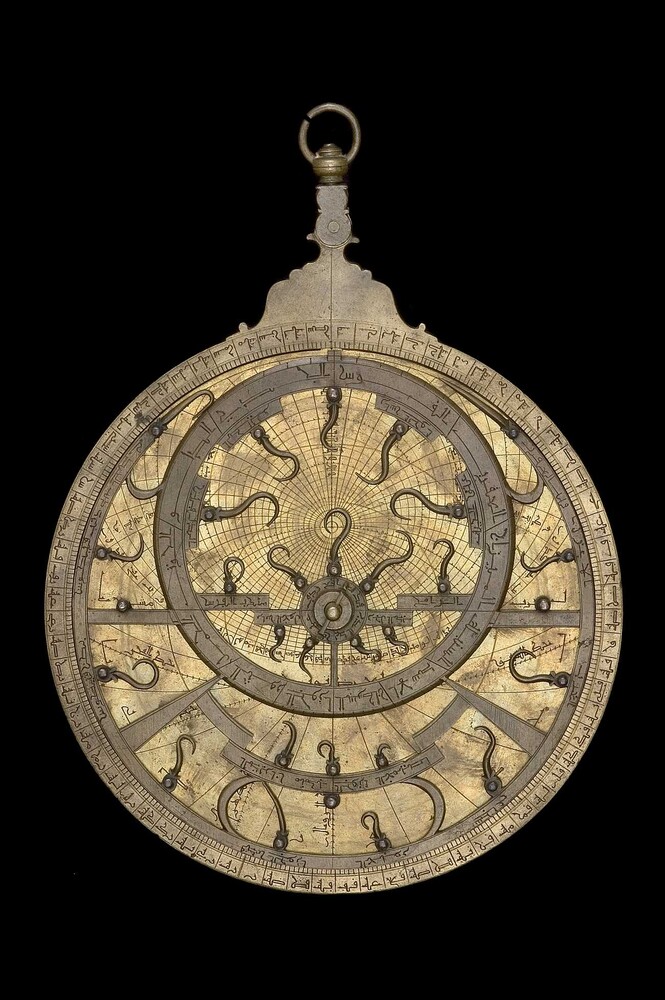 Astrolabe, by Muhammad ibn Ahmad al-Battuti, North African, 1728/9Inventory Number 52713
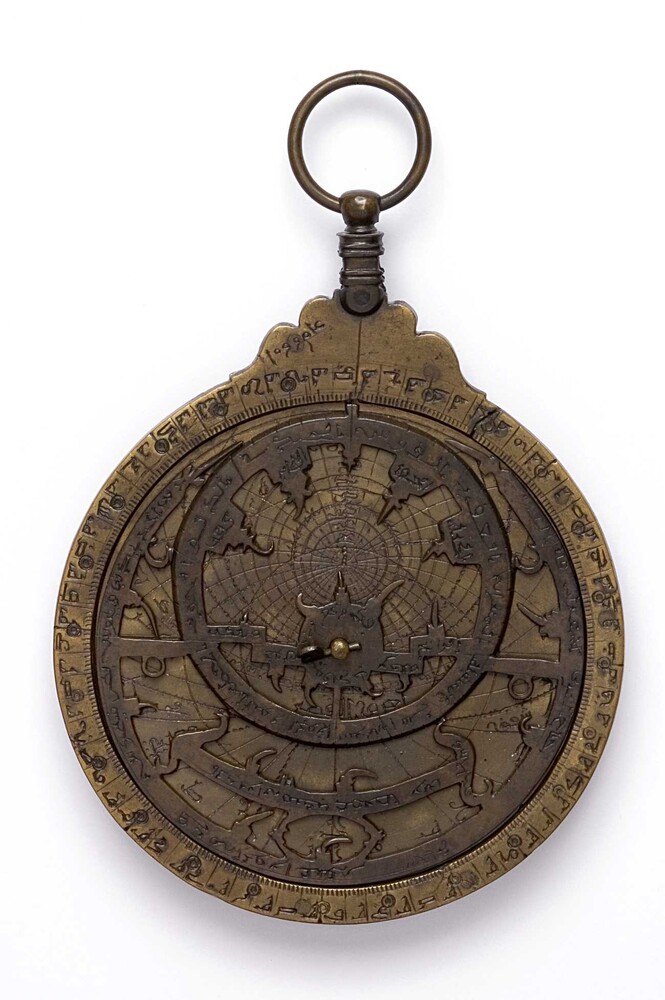 Astrolabe, by Adbullah ibn Sasi, North African, 1687/8Inventory Number 45220
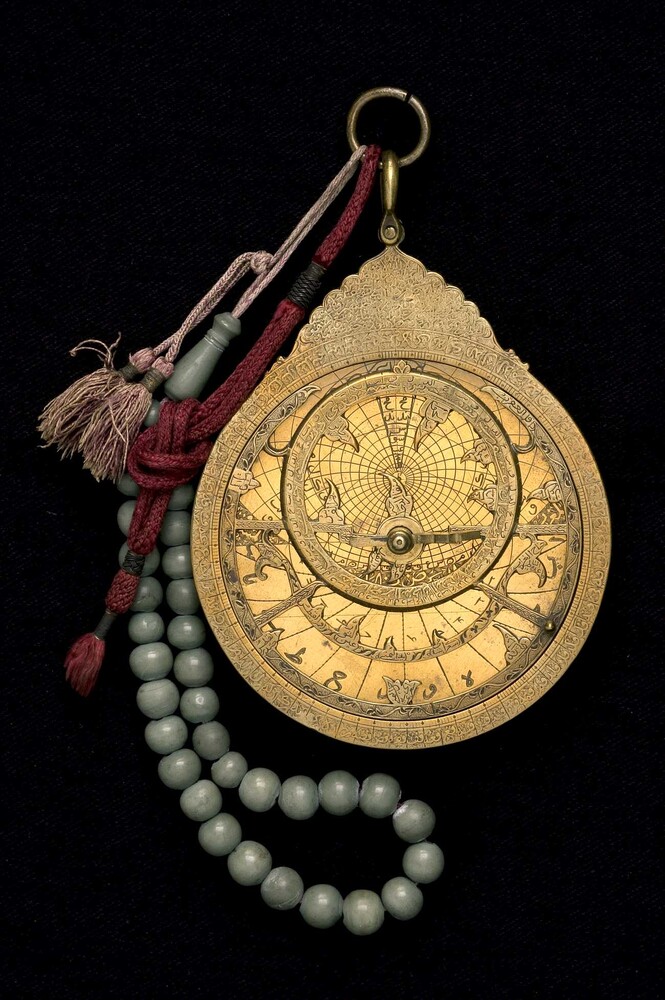 Astrolabe, by Khalil Muhammad ibn Hasan `Ali, Persian, c. 1700Inventory Number 42649
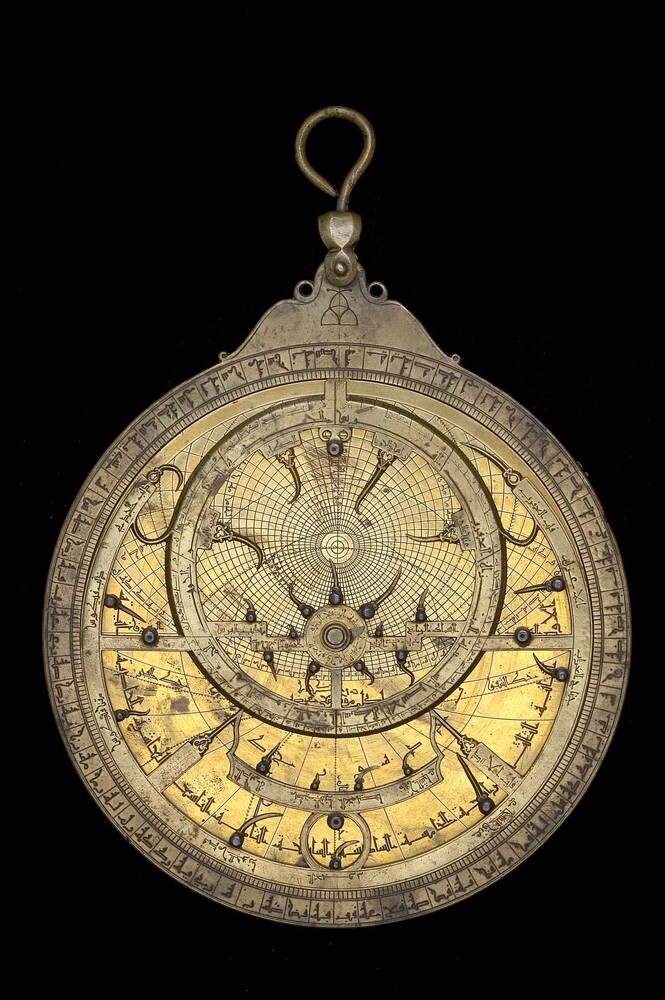 Astrolabe, by Muhammad ibn Fattuh al-Khamairi, Seville, 1224/5Inventory Number 50934